You have spent months perfecting your product concept. The renders look stunning. The prototype works — mostly. Now it is time to manufacture at scale, and suddenly your per-unit cost is double what you projected. The tooling engineer sends back a list of 47 design changes. Your launch date slips another quarter.
This is the moment most hardware startups discover Design for Manufacturing (DFM) — often too late. In 2026, DFM is not just a nice-to-have. It is the difference between a profitable product and an expensive lesson.
What Is DFM?
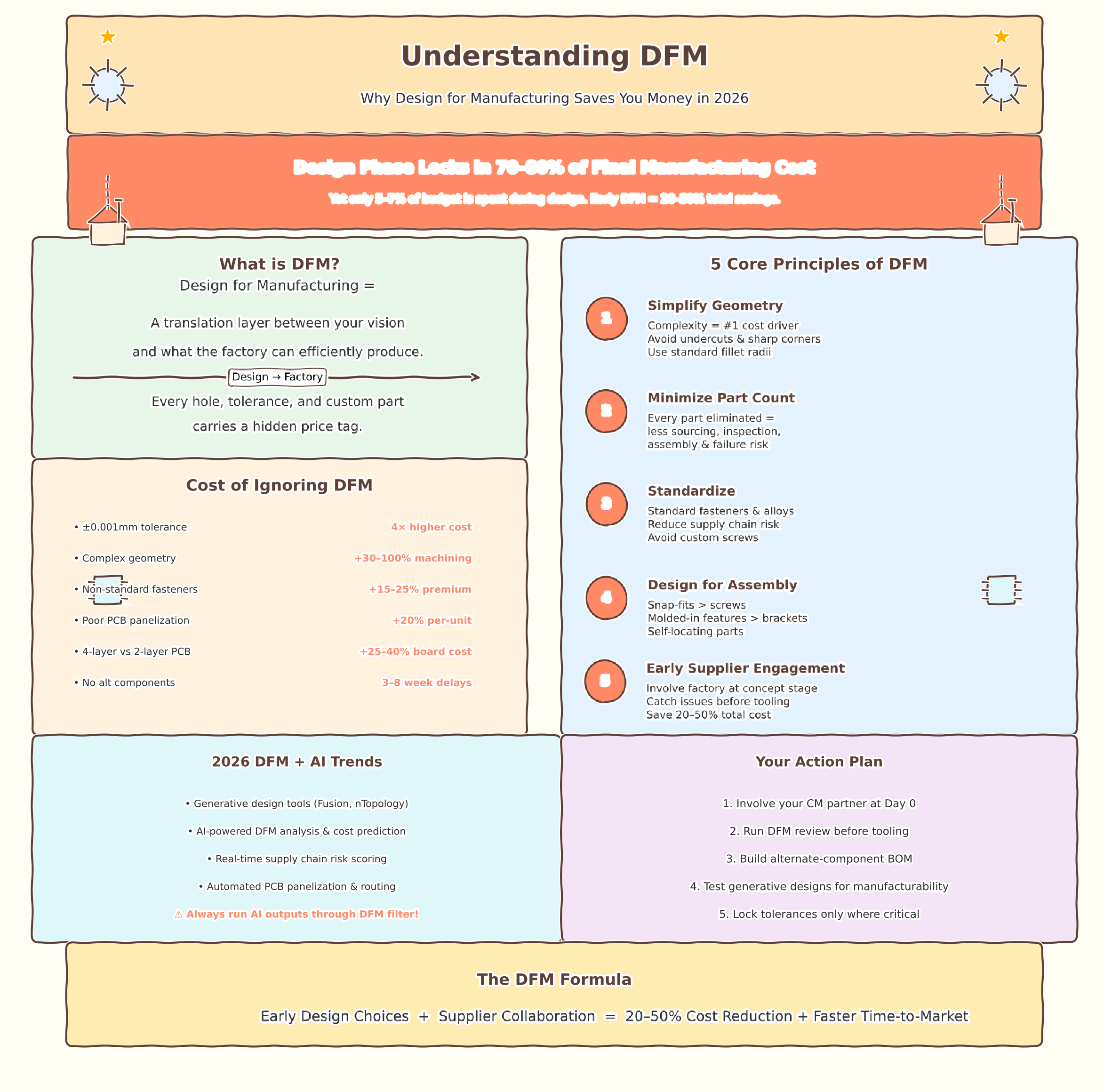
Design for Manufacturing is the practice of designing products in a way that optimizes them for the manufacturing process before production begins. Think of it as a translation layer between what you want to make and what your factory can efficiently produce.
Here is the critical number: decisions made during the design phase lock in 70–80% of a product's final manufacturing cost, even though design spending represents only 5–7% of the total budget.
The Cost of Ignoring DFM
| Mistake | Cost Impact |
|---|---|
| Over-specified tolerances | 4x higher part cost |
| Unnecessary geometric complexity | +30–100% machining time |
| Non-standard fasteners | +15–25% premium |
| Poor PCB panelization | +20% per-unit cost |
| 4-layer vs 2-layer PCB (unneeded) | +25–40% board cost |
The 5 Core Principles of DFM
1. Simplify Geometry
Complexity is the #1 cost driver. Every unnecessary curve, undercut, or decorative feature adds tooling cost. Use standard shapes and consistent fillet radii wherever possible.
2. Minimize Part Count
Every component eliminated means one less part to source, inspect, stock, and assemble. A well-designed molded housing can replace 5–10 separate parts.
3. Use Standard Materials
Custom alloys and proprietary components are supply chain traps. Stick to commonly stocked plastics (ABS, PC, PP, TPU) and standard fasteners (M2, M3, M4) available from multiple suppliers.
4. Optimize Tolerances
Tightening tolerance from ±0.1mm to ±0.01mm can quadruple machining cost. Apply tight specs only where functionally critical — bearing seats and shaft fits. For hidden internal surfaces, use the loosest acceptable tolerance.
5. Design for Assembly (DFA)
Use poka-yoke features to prevent incorrect assembly. Design for top-down assembly where gravity assists. Standardize fastener types. Products built with DFA principles see 30–50% reductions in assembly time.
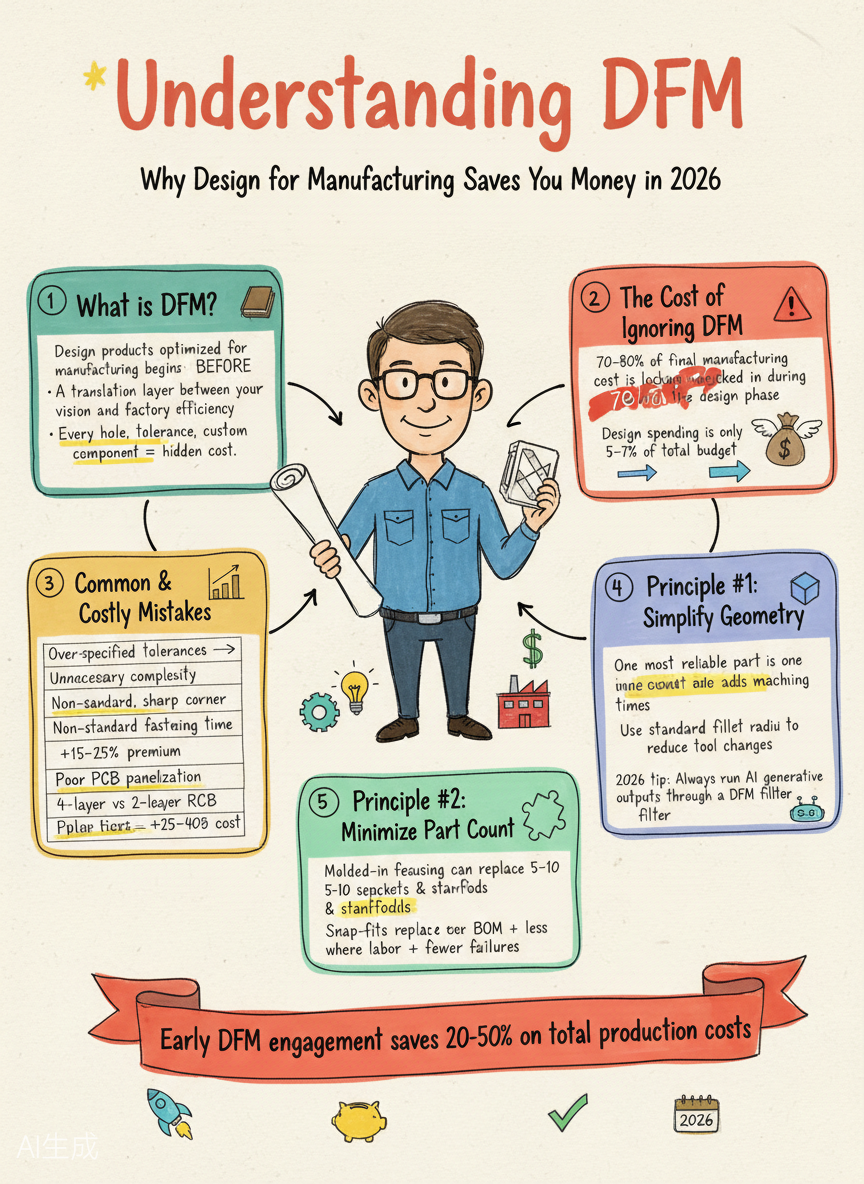
The five DFM principles in action — from concept to cost-optimized production
When to Engage Your Manufacturing Partner
The most important advice in this guide: bring your manufacturing partner into DFM during the concept phase — not after your design is "finished."
| Phase | Relative Cost of Change |
|---|---|
| Concept / Early Design | 1x (baseline) |
| Detailed Design | 5–10x |
| Prototyping | 20–50x |
| Pre-production / Tooling | 100–1,000x |
| Mass Production | 10,000x+ |
DFM in 2026: Three Trends
AI-Powered DFM Analysis: Tools like Autodesk DFM and DFMPro now analyze 3D models and flag manufacturability issues in minutes — tasks that once took senior engineers hours.
Digital Twin Simulation: Leading Chinese manufacturers create virtual replicas of production lines to simulate manufacturing before cutting any physical tooling.
ESG Compliance: EU regulations (ESPR, PPWR) now require recycled content and carbon disclosures. DFM guides material selection toward recyclable plastics (rABS, rPP) and designs for disassembly.
Bottom Line
Hardware startups that embed DFM from day one — in partnership with a manufacturer who brings genuine engineering expertise — build products that are cheaper to produce, faster to market, and more resilient to supply chain disruption.
The math is compelling: 20–50% cost savings, dramatically improved yields, shorter development cycles, and fewer nasty surprises at production ramp-up.
Ready to optimize your product? Send us your design files for a free DFM review and cost estimate.
Published: June 19, 2026 | Category: Product Development & Manufacturing Guide
Comments (3)
The tolerance optimization section hit home. We specified ±0.01mm on cosmetic surfaces that did not need it and paid 3x for machining. Never again.
We adopted the early DFM engagement approach with our Shenzhen partner last quarter. Caught a draft angle issue before tooling that would have cost us $6,000 to fix. This guide validates our decision.
Great infographic at the top. Shared it with our design team. The PCB panelization tip alone — we were wasting 35% of panel area with an irregular board shape. Rectangular redesign cut unit cost by 18%.
Leave a Comment