If you run a design studio, here is an uncomfortable truth: your clients are no longer buying what you think you are selling.
For decades, the core product was the drawing. Floor plans, 3D renderings, construction documents, and material boards were the deliverables that justified the invoice. Clients asked for them. Agencies competed on how photorealistic they looked. Portfolios were judged by visual impact.
But something has changed. The tools have become cheap, fast, and good enough. A founder with a Midjourney account and a freelance CAD operator can produce a rendering that looks impressive in a board deck. The images are no longer scarce. What is scarce is the judgment to know which image is worth building.
That is why the most successful design partners today do not sell drawings. They sell judgment, process, and client decisions.
The Three Layers of Real Value
If you want to escape the commoditization of pretty pictures, you need to reorganize your offering around three things the client cannot generate from a prompt.
1. Judgment: Helping the Client See What Actually Matters
Judgment starts before the first sketch. It is the work of understanding the real need, spotting the real opportunity, and recommending a strategy that fits the client's constraints.
In product development, this means asking questions deeper than "what do you want it to look like?" It means diagnosing whether the market gap is real, whether the feature set can be manufactured at target cost, and whether the schedule is even possible without burning the budget.
A partner with strong judgment does not just collect requirements. They challenge them. They tell the client when a requested feature is a distraction, when a cheaper material is good enough, or when a six-month launch window is about to become twelve. That is the value of experience. It cannot be downloaded.
2. Process: Making the Path Predictable
Clients pay a premium for predictability. They want to know what happens next, when they will be asked to decide, and how the project is protected from the usual surprises.
A process-driven design partner offers a clear sequence: how research feeds strategy, how strategy shapes the concept, how the concept gets validated, and how validation turns into production-ready files. Each phase has a gate. Each gate has a decision. Each decision has the documents the client needs to move forward.
This is especially important in hardware and consumer electronics, where a single late-stage tooling change can erase the entire project margin. A reliable process does not eliminate risk, but it makes risk visible early, when it is still cheap to manage.
3. Client Decisions: The Only Deliverable That Actually Matters
At the end of every phase, the client has to make a call. Go left or right. Spend more or protect cash. Launch now or fix the flaw. The design partner's job is to make that decision as easy and as well-informed as possible.
This means presenting value clearly, comparing real options side by side, and providing the supporting analysis the client needs to defend the choice internally. It means translating engineering trade-offs into business language. It means giving the client confidence not just in the design, but in the decision to build it.
When a design partner does this well, the client stops seeing them as a vendor and starts seeing them as a strategic ally.
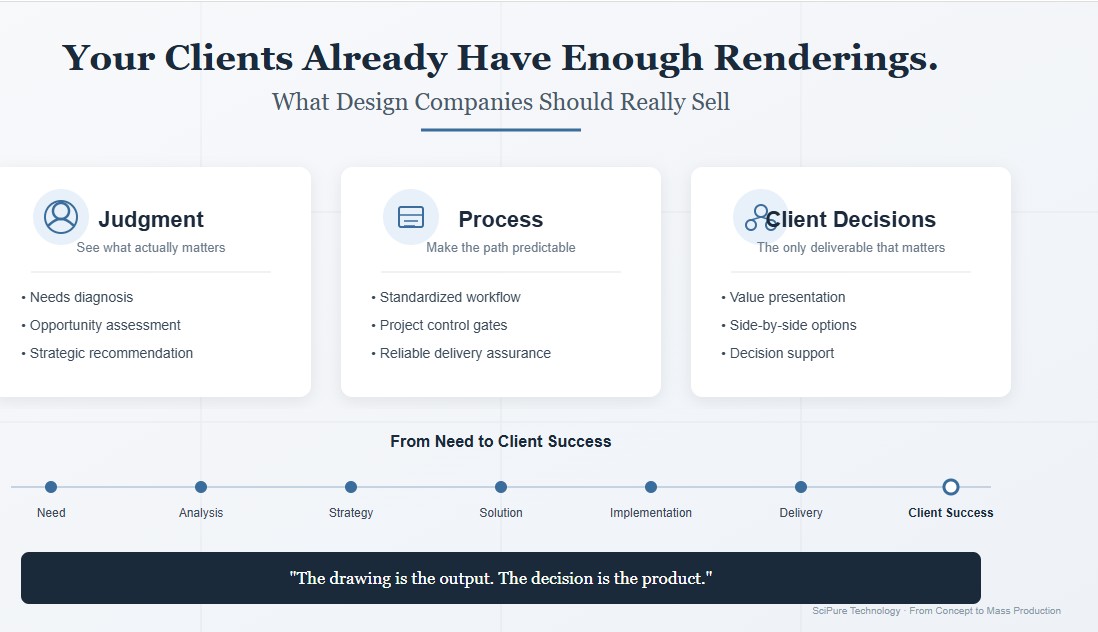
Judgment · Process · Client Decisions — the three layers of value no AI can replace
What the New Client Journey Looks Like
The shift from drawing delivery to decision delivery changes the shape of the engagement. Instead of a linear handoff, the process becomes a shared journey with clear decision points:
| Phase | What Happens | Client Decision |
|---|---|---|
| Need | The client describes a problem. The partner listens for what is really being asked. | Is this the right problem to solve? |
| Analysis | Research into users, market, technology, and manufacturing constraints. | Do the insights justify investment? |
| Strategy | A clear direction is recommended. This is where judgment shows up. | Do we commit to this path? |
| Solution | Concepts and prototypes developed in service of a decision, not as an end. | Which concept do we build? |
| Implementation | Engineering, sourcing, and tooling move the design toward reality. | Are we ready to cut steel? |
| Delivery | Production-ready assets plus the decision record explaining why. | Are we confident to launch? |
| Client Success | The real finish line: launching with confidence and selling the product. | Did we make the right calls? |
Why This Model Wins
Selling drawings is a race to the bottom. There will always be a cheaper renderer, a faster drafter, or a hungrier freelancer. Selling judgment, process, and decisions is a race you can actually win, because it is built on trust, track record, and the ability to think.
For a product engineering consultant with twenty years of experience taking ideas to mass production, this model is a natural fit. The drawings are still part of the service. But the reason clients pay more is not the files. It is the confidence that the files represent the right decision.
How to Start Making the Shift
If your studio is still organized around image delivery, the transition does not have to be dramatic. Start by changing one thing: at every milestone, ask what decision the client needs to make, and what you can give them to make it confidently.
Rename your deliverables if you have to. A "rendering package" becomes a "concept selection brief." A "construction document set" becomes an "implementation decision kit." The language signals the value.
Then build the process that supports it. Document your phases. Define your gates. Train your team to present options with trade-offs, not just recommendations with enthusiasm.
Most importantly, measure success by client outcomes, not portfolio aesthetics. Did the product launch? Did it hit cost? Did the client come back for the next project?
The Bottom Line
Clients do not wake up wishing they had more pictures. They wake up wishing they knew what to do. The design firms that understand this will stop competing on rendering quality and start competing on clarity, confidence, and results.
The drawing is the output. The decision is the product. Sell the decision.
Need a product design partner who helps you make the right calls from concept to mass production? Book a free consultation and let's talk about what you are actually trying to ship.
Published: July 30, 2026 | Category: Design Strategy & Client Partnership
Comments (3)
We just renamed our "rendering package" to "concept selection brief" after reading this. First client meeting with the new framing: the client actually asked for our recommendation instead of demanding more variations. One language change, completely different dynamic. Thank you.
The three-layer framework crystallized something I'd been feeling but couldn't articulate. We fired two clients last quarter who only wanted prettier renders. Replaced them with one who pays 3x more for our judgment on manufacturability. Revenue up, stress down. This article is our new onboarding doc.
The client journey table is now printed and pinned above my desk. "Did the product launch? Did it hit cost? Did the client come back?" — three questions that cut through all the portfolio vanity metrics. Shared this with our entire design leadership team.
Leave a Comment