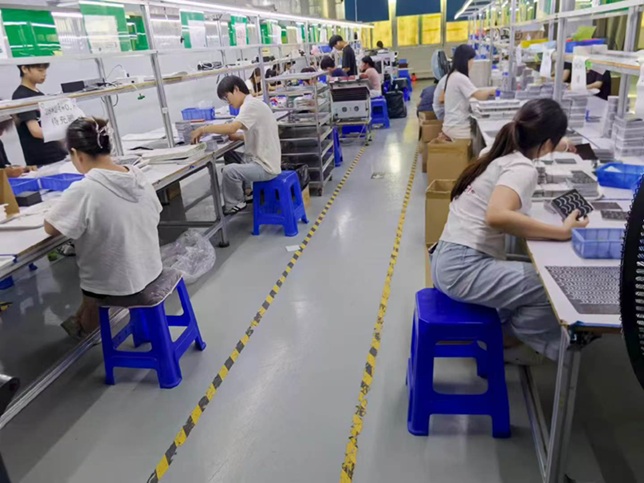
Factory vetting in 2026 is no longer the act of confirming a building exists and its machines run — it is the act of proving, with documents a U.S. customs officer will accept, that every tier of your supply chain is clean.
The Audit That Passed — and the Shipment That Didn't
Daniel did everything the 2024 playbook told him to. It still wasn't enough.
Daniel runs a small connected-fitness brand out of Toronto. His first product — a Bluetooth resistance-band trainer with a molded housing and a small electronics pod — had closed a quiet $180K seed round, and he'd found a manufacturer in Dongguan through a sourcing agent. The factory had an ISO 9001 certificate (current), a clean B2B-platform storefront, and a video tour that showed real injection-molding machines running real parts. Daniel's agent ran a Pre-Shipment Inspection; the report came back with a 1.3% defect rate, well inside his tolerance. He paid the balance, the containers sailed, and he went to bed relieved.
Six weeks later the containers were sitting in a U.S. bonded warehouse, and CBP had issued a detention notice under the Uyghur Forced Labor Prevention Act (UFLPA). The reason was not the factory. It was the polymer pellets: the resin supplier two tiers upstream could not produce a Certificate of Analysis or any labor-source documentation, and CBP's automated system had flagged the shipment's non-originating component content. Daniel's $480,000 of inventory — product he'd already presold to 3,200 customers — was frozen, and the burden of proof was on him to show the entire chain was clean.
The moment we realized it, we were on a call at 11 p.m. his time. He was frustrated, a little panicked, and not sleeping. "We almost told him it was fine" is the honest version — because on paper, the factory was fine. The gap wasn't the building. It was everything the building bought from.
At SciPure Tech (溯朴科技) our founder came out of the Foxconn-Apple joint lab — two decades of carrying consumer electronics and home products from a whiteboard concept to tens of millions of identical units. We hold 29 granted patents, and our founder was named a Shenzhen science-and-technology leadership talent in 2020. We are a Shenzhen-based product engineering advisor: we help consumer-electronics and home brands manage the full journey from concept design to mass-production management — DFM optimization, injection molding, electronics assembly, QC systems, and supply chain development — backed by our own 2,000 m² production facility in Shenzhen's Guangming District (海鑫光高科技工业园), ISO 9001 certified, running IQC/IPQC/FQC/OQC across the full process with an AQL 1.0 outgoing standard. We have capacity; what we sell is engineering judgment. Clients can build on our lines or take the design package back to their own factory — the engagement doesn't depend on it either way. Since 2024 we've watched the failure mode shift: the disaster is rarely "the factory lied about its machines" anymore. It's "nobody traced the inputs."
Vetting in 2026 Means Vetting the Chain, Not the Building
The single biggest change since 2024 is that a clean factory audit no longer implies a cleareable shipment. A factory can be impeccably run and still be one undocumented resin lot away from a border hold. What you are actually buying in 2026 is not a building's capability — it's a documented chain of custody from raw material to carton.
Here is the uncomfortable part most founders miss:
- The factory is one node. Your real exposure runs through pellet suppliers, PCB houses, capacitor distributors, plating shops, and packaging printers — entities you will never see on a video tour.
- CBP scrutinizes inputs, not intentions. Under UFLPA, the default assumption is "forced labor involved" until proven otherwise with evidence. A friendly sales rep cannot produce that evidence; only the upstream supplier's records can.
- A trading company magnifies the gap. If your "factory" is actually a trading company, it may not even know its subcontractors' subcontractors. That is precisely the structure that fails at the border.
The takeaway: treat supply-chain traceability as a qualification gate that sits before the production PO — not as a fire drill you run after a detention notice.
The 2026 Compliance Stack: What Actually Changed
Three 2026 policy shifts turned supply-chain documentation from a nice-to-have into a customs gate. If you sourced in 2024 and haven't re-checked your assumptions, this is what moved:
- Section 301 forced-labor tariff (effective July 24, 2026). A new 12.5% tariff on Chinese-origin goods (one of 46 economies) now stacks on the existing 25% Section 301 China surcharge, pushing the aggregate duty on typical consumer goods to roughly 37.5%. (Source: USTR final action, July 23, 2026; China-Briefing tariff tracker.)
- De minimis ended (February 2026). The $800 de minimis exemption is gone for all origins. Every commercial shipment now needs formal entry and full documentation — there is no low-value lane to hide a thin paper trail in. (Source: White House EO, Feb. 20, 2026.)
- UFLPA enforcement is accelerating. As of 2026, CBP's UFLPA dashboard shows roughly 1,268 shipments detained, about $549M in value. The agency has institutionalized automated flags on shipments with high non-originating component content. (Source: CBP UFLPA dashboard guidance, 2026.)
- New federal self-audit tools (April 8, 2026). The U.S. Department of Labor launched LaborShield, ImportWatch, SourcingStrong, and the Supply Chain Traceability Portal — free tools that frame forced-labor diligence as routine business hygiene, not crisis response. (Source: U.S. DOL press release, Apr. 8, 2026.)
- A second Section 301 "excess capacity" probe (launched March 11, 2026) now covers 16 economies including China, targeting aluminum, autos, batteries, electronics, semiconductors, and more — a sign the duty stack is not done growing. (Source: USTR fact sheet, March 2026.)
The management translation is simple: in 2026, your manufacturing partner's compliance infrastructure matters as much as its production capability. A beautiful factory with an opaque chain is a liability, not an asset.
A Decision Tree You Can Run This Week
The right vetting depth depends on your volume, your product's component origin, and who actually builds it — not on a generic checklist. Use this:
- If you are pre-tooling and still choosing a partner → require a traceability package before you sign: named resin/PCB/key-component suppliers, their business licenses, and a labor-source attestation. If a candidate cannot produce these in writing, that is your answer.
- If you are a low-volume importer (under 5,000 units/SKU) → China remains the most accessible option; don't flee to Vietnam to "avoid compliance." Vietnam itself imports ~80% of its industrial components from China, so you'd often inherit the same exposure at 2–4x the MOQ. Vetting the chain beats changing the address.
- If your product has Chinese electronics or metal content → assume CBP will scrutinize non-originating value. Build the evidence file (COAs, mill certs, supplier declarations) now, not when a container is detained.
- If you are working through a trading company → insist they name the actual subcontractor and let you audit that entity. A trading company that refuses to name its shop is telling you everything.
- If you have no engineering partner yet → bring one in before the PO. The cost of tracing the chain upfront is a fraction of one detained shipment's storage and legal fees.
How AI Is Reshaping Remote Verification (Both Ways)
AI now makes remote factory verification both sharper and easier to fake — so the irreducible checks are the ones AI can't spoof. On the helpful side, supplier-quality management has moved from periodic audits to continuous monitoring: AI vision inspection now reaches 90–99% defect-detection accuracy (up from 60–85% for manual checks) at under 200 ms per unit, and IDC projects that by 2026, 45% of G2000 OEMs will connect field and engineering data through AI to lift quality and cut cost. (Sources: iFactory / Rock & River 2025 benchmarks; IDC FutureScape 2026.) AR-enabled remote inspection (JD Industrial's 2026 rollout) lets a quality team in another city run standardized checks through a supplier's AR glasses, with the whole session recorded — a genuine substitute for some on-site visits.
The flip side is deception. Deepfake video calls, AI-generated facility photos, and synthetic certificates with convincing layouts but fictional accreditation numbers are now cheap. That is exactly why the government-database checks — business-license cross-reference, litigation history, customs records — have become more important, not less. AI can fake a photo. It cannot forge a gsxt.gov.cn entry or a court record with consistent cross-references. Keep those checks non-negotiable.
What We Do Differently at SciPure
At SciPure we don't discover partners from search results; we qualify them over years and audit the chain, not just the building. When we manage a program, our engineers sit at the actual production line during critical phases, we run pre-production trials before your order is committed, and we require supplier-level traceability docs as a condition of the engagement — not a favor after the fact. Across the programs we've run, the founders who sleep best are the ones who treated "can you prove your chain is clean?" as question one, not question nineteen.
We are a Shenzhen team with our own ISO 9001 lines, but the value we sell is the judgment to ask the questions a non-engineer wouldn't think of — and to recognize a staged showroom from a real one because we've built both. You don't need to fly to Shenzhen to vet a partner properly. You do need a protocol that goes at least two tiers deeper than the building in front of you.
The Principle Worth Taking Away
Here's the thing nobody tells you at the start: a factory audit proves the building is real; only a supply-chain traceability file proves the shipment will clear. In the 2026 compliance era, the question is no longer "is this a good factory?" — it's "can you show me, in documents, where every gram came from?" Daniel eventually cleared his shipment, but only after eight weeks and a five-figure legal bill that a single upfront document request would have prevented. The brutal truth is that the cheapest customs hold is the one you never get, because the paper trail was built before the steel moved.
"We used to treat the factory audit as the finish line. In 2026 it's just the front door — the chain behind it is what actually clears the border, or doesn't." — Program lead, North American home-goods brand
Frequently Asked Questions
Do I need to visit the factory in person to vet a Chinese manufacturing partner?
No. A rigorous remote protocol — business-license cross-reference, live video line walks, engineering interviews, document authentication, and third-party pre-shipment inspection — catches the vast majority of risks without a flight. At SciPure we've qualified partners we've never physically visited by going at least two tiers deep into the supply chain and verifying official records that AI and showrooms cannot fake.
What supply-chain documents should I require in 2026?
Require, before any production PO: named resin/PCB/key-component suppliers with business licenses; Certificates of Analysis (COAs) with batch numbers; mill or material certifications; and a written labor-source attestation for each tier. Under UFLPA the burden of proof is on the importer, so the file must trace raw material to carton — not stop at the factory door.
How do the 2026 tariffs change the vetting math?
Since July 24, 2026, Chinese-origin consumer goods face roughly 37.5% aggregate duty (a 12.5% Section 301 forced-labor tariff stacking on the existing 25% Section 301), and the $800 de minimis exemption ended in February 2026, so every shipment needs formal entry. This raises the cost of both non-compliant rework and any part you later have to re-source — another reason to qualify the chain upfront.
Can AI tools replace on-the-ground verification?
Not fully. AI vision and AR remote inspection are excellent for continuous quality monitoring and some audit substitutes (90–99% defect detection, IDC: 45% of G2000 OEMs on AI quality by 2026). But AI also enables deepfakes and synthetic certificates. Keep the government-database and document-authentication checks non-negotiable — those are the ones AI cannot spoof.
How early should I bring in a manufacturing or engineering partner?
Before the production PO and ideally before tooling is cut. At SciPure the median cost of a change caught after tooling is about 14x the cost of the same change caught earlier, and traceability gaps are cheapest to close when no steel has moved. The partner you bring in early is the one who asks "where does your resin come from?" on day one.