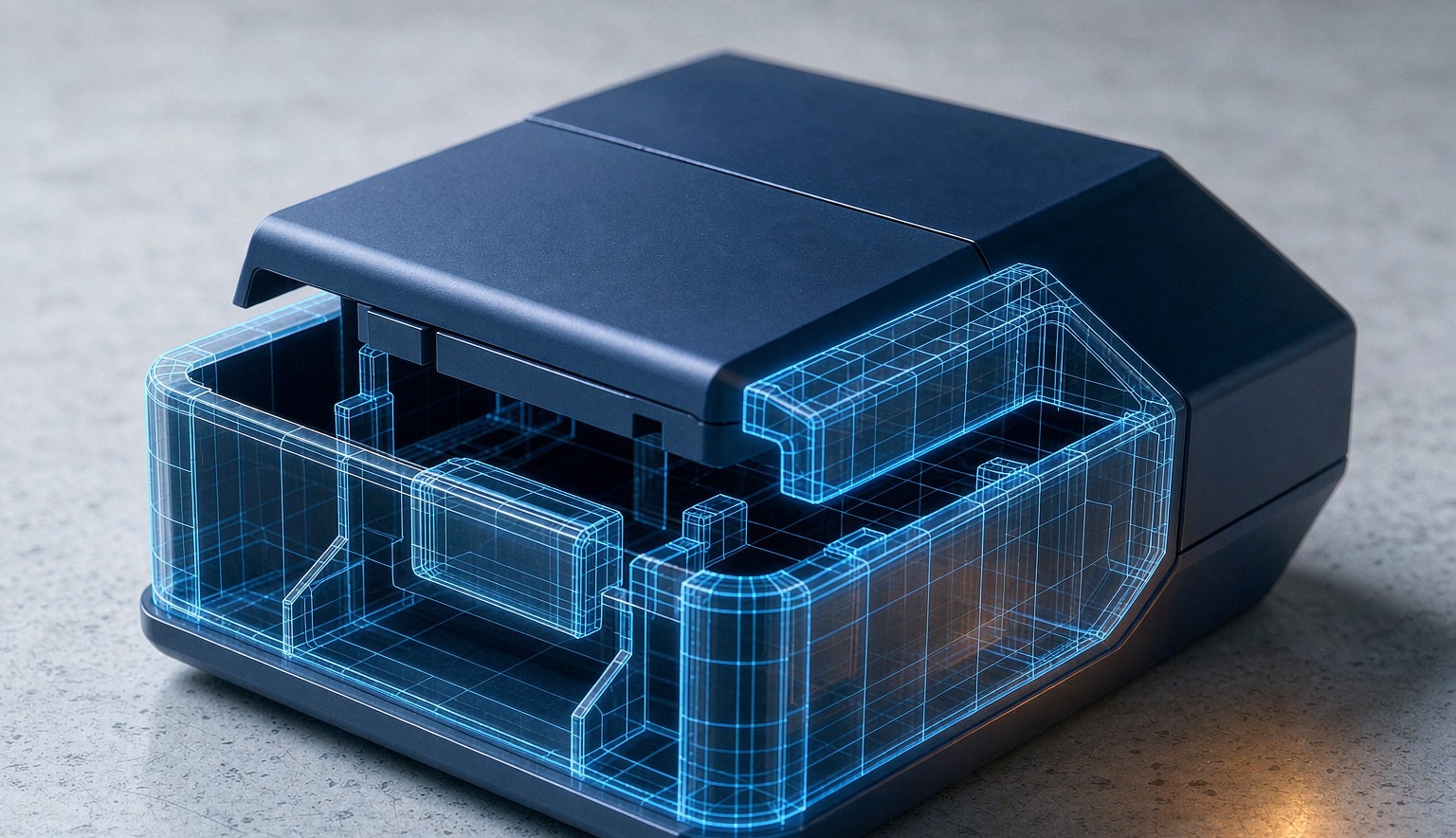
DFM (Design for Manufacturing) means designing a part so it can actually be made — cheaply and reliably. At SciPure, a product-engineering advisor that takes hardware from concept to mass production, we keep seeing the same three issues behind most tooling rework. You don't need an engineer to catch them.
1. Keep wall thickness uniform
Thick sections next to thin ones cause sink marks, warpage, and trapped air. Pick one nominal wall — about 2 mm for ABS — and hold it across the part. If a rib or boss must be thicker, taper it in gradually. Uniform walls fill evenly and come out flat.
2. Add a draft angle
Every vertical face that touches the mold needs a slight taper — 1°–2° is usually enough — so the part releases without sticking or scraping. Forgetting draft is the fastest route to extra ejection pins, manual finishing, and a second tooling revision.
3. Cut the part count
Every extra molded piece means another tool, another assembly step, another failure point. Ask: can two shells snap together instead of three? Can a feature be molded in rather than glued on? Fewer parts almost always means lower cost and higher yield.
None of this replaces a proper DFM review — but running these three checks before you approve a quote will spare you a tooling revision or two. Send us your model and we'll flag the expensive bits in a short call.