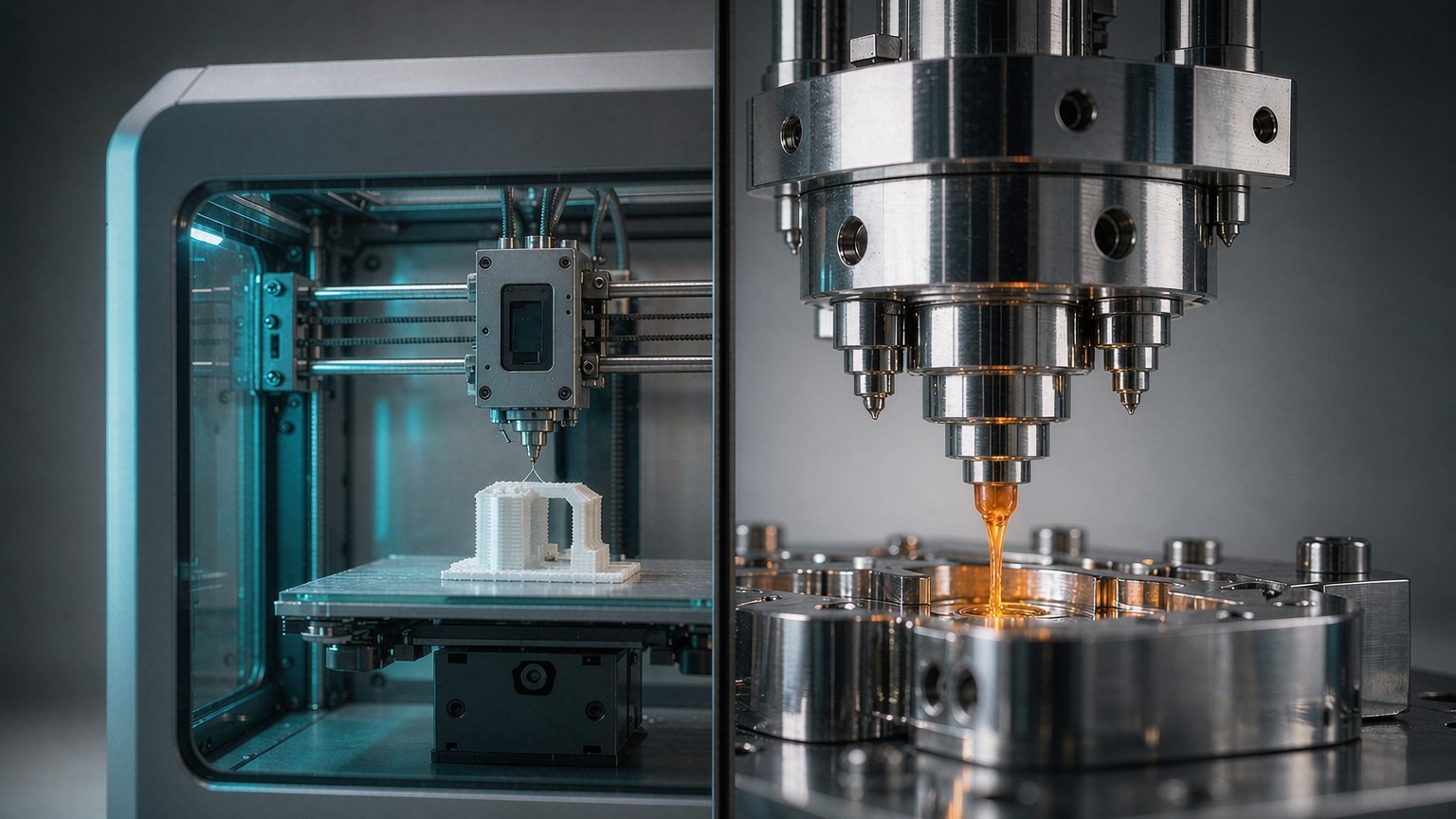
3D printing vs injection molding is a manufacturing decision about where your product sits on the volume curve — not a contest of which technology is "better." Get that curve wrong and you either burn cash on tooling you don't yet need, or stall a product that was ready to scale. Here is the near-miss that explains why the spreadsheet your board fell in love with is usually the wrong lens.
The $48,000 Bet Her Board Almost Made
The most expensive mistake in early hardware is not picking the wrong process — it is committing to the expensive one before you have earned the volume that justifies it.
Last spring, Lena (a founder we'll call her that) brought us a smart-home sensor with a gorgeous SLA prototype. Her board loved the demo. They wanted steel tooling: $48,000, a 14-week lead, paid before a single unit had been sold. We almost let it happen. The moment we realized the prototype had validated the idea, not the market, we ran the numbers — and the numbers said printing the first 2,000 units would cost less than a third of that tool, with zero commitment. She was relieved. Her CFO had been sleepless until he saw the spreadsheet.
At SciPure Tech (溯朴科技) our founder came out of the Foxconn-Apple joint lab — two decades of taking consumer electronics and home products from whiteboard concept to tens of millions of identical units. We hold 29 granted patents, and our founder was named a Shenzhen science-and-technology leadership talent in 2020. We are a Shenzhen-based product engineering advisor helping consumer-electronics and home brands manage the full journey from concept design to mass production — DFM optimization, injection molding, electronics assembly, QC systems, and supply chain development — backed by our own 2,000 m² production facility in Shenzhen's Guangming District (海鑫光高科技工业园), ISO 9001 certified, running IQC/IPQC/FQC/OQC full-process inspection with an AQL 1.0 outgoing standard. We have capacity; what we sell is engineering judgment. Clients can build on our lines or take the design package back to their own factory — the engagement does not depend on it either way. Lena's near-miss is exactly the kind of call we exist to make.
3D Printing vs Injection Molding: Where the Curves Actually Cross
For a typical small consumer-plastic part, injection molding only beats 3D printing on total cost once you clear roughly 1,000–2,000 units — and after 2026 tariffs, that crossover has crept higher, not lower.
Here is a worked example for a common consumer-electronics shell (100 × 60 × 20 mm, medium curvature, no complex undercuts). The numbers track 2026 China market quotes compiled by molding and 3D-printing service bureaus:
- 3D printing (SLA, sanded + painted): ~$3.90 per unit, $0 tooling, first parts in 24–48 hours.
- Injection molding (China P20 steel mold): ~$4,200 tool + ~$0.42 per unit, mold built in 30–45 days.
- Same mold, landed with the 2026 Section 301 25% tool tariff: ~$5,250 + $0.42 per unit.
| Batch | 3D printing total | IM total (pre-tariff) | IM total (landed, +25% tool tariff) |
|---|---|---|---|
| 100 pcs | $390 | $4,242 | $5,490 |
| 500 pcs | $1,950 | $4,410 | $5,660 |
| 1,000 pcs | $3,900 | $4,620 | $5,880 |
| 1,200 pcs | $4,680 | $4,704 | $6,030 |
| 2,000 pcs | $7,800 | $5,040 | $6,290 |
| 5,000 pcs | $19,500 | $6,300 | $7,550 |
| 10,000 pcs | $39,000 | $8,400 | $9,650 |
The key numbers, listified so they are easy to lift:
- Break-even on total cost lands near 1,200 units pre-tariff — below that, 3D printing wins decisively.
- With the tariff-loaded tool, molding's total-cost advantage only appears later, because the entry fee got more expensive, not the per-part rate.
- Resin and powder cost 8–15× more per weight than injection-grade thermoplastic — so at high volume, molding pulls away hard (at 10k units, molding is ~24% of the printing total).
- A US or EU steel mold runs 2–3× the China quote, which pushes the crossover even higher for domestic tooling.
The trap is treating the per-unit line as the whole story. It isn't — the tool is a bet you place up front. For the deeper process trade-offs, see our guide on 3D printing vs injection molding cost.
The 2026 Twist: Tariffs Moved the Goalposts
In 2026 the break-even is not just a function of volume — it is a function of where the mold and the parts clear customs.
- Section 301 on Chinese tooling (HTS 8480) adds 25%; on production parts (HTS 3926 and many categories) the rate is 25%+, and stacked readings reach 40% on some programs. (Sources: vncontx.com 2026 tooling benchmark; qlutionmold.com; corelmould.com.)
- A practical case: a $12,000 Shenzhen mold adds ~$3,000 in duty on the tool alone, and a first run of 50,000 parts at $0.60 each adds another ~$7,500 — over $10,000 of tariff on a program that looked competitive on the ex-works quote. (Source: vncontx.com.)
- The net effect: tariffs widen the window where 3D printing and rapid tooling win, because they raise the cost of committing to steel before volume is proven.
- AI-assisted DFM and RFQ platforms now compress quote turnaround from 2–3 weeks to 3–5 days — useful, but it changes your speed, not your volume math. (Source: MoldMinds 2026 offshore tooling analysis.)
None of this means "never tool." It means the old "1,000 units and you're golden" rule of thumb is stale. The 2026 answer is closer to 2,000–5,000+ units before steel pays off once duties and design-revision risk are counted.
How Do You Decide Between 3D Printing and Injection Molding?
Use volume, design-frozen status, and tariff exposure as the three filters — not the material your prototype happened to use.
- If annual volume is under ~1,000 and the design is still moving → 3D printing (SLA / SLS / MJF). Zero tooling, edit the CAD, reprint. This is also the right answer when you are still learning how the 3d print prototype vs production gap behaves in real material.
- If you need 1,000–10,000 real-thermoplastic parts for a pilot or bridge run but cannot yet bet on volume → rapid aluminum tooling ($3,000–$8,000, 1–2 weeks, 1,000–50,000 shots). It is the agile middle that most early hardware actually needs.
- If volume clears ~10,000 (or 25,000–60,000 effective once cash, tariff, and revision risk are counted) and the design is frozen → steel tooling. This is where injection molding cost per part finally justifies the entry fee.
- If the program is tariff-exposed → model landed cost, not ex-works. One proven structure is to build the mold in China and run production domestically, capturing the tooling saving while dodging per-part duties. (Source: plasticmoulds.net 2026.)
A fourth option is emerging fast: 3D-printed molds now cut tooling cost 80–90% and compress lead time from weeks to days (an IPC France study using Formlabs Rigid 10K + PA12; ORNL and polySpectra are targeting sub-$1,000 tools). Treat them as a front-end filter — validate in real material, then commit to hard steel only after the market shows up. That sequence used to cost months and tens of thousands; now it costs days and hundreds.
When you are pre-tooling, the highest-leverage move is a structured DFM review — see how one pre-tooling pass on how to reduce manufacturing cost before tooling cut a founder's quote by 31%. And remember the bigger truth from design for manufacturing reduce manufacturing costs: roughly 80% of unit cost is committed before steel is ever cut.
The Principle: Tooling Is a Bet on Certainty
Tooling is a bet on certainty; 3D printing and rapid tooling are how you buy optionality until the market proves you right.
The logic is older than the technology. A long-standing product-development principle holds that 70–80% of a product's lifecycle cost is locked in by the time the design freezes — which is exactly why rushing to tool is dangerous before the design (and the demand) is settled. And speed has its own reward: research cited in 2026 sourcing analysis indicates the first product to market in a new category can capture up to 70% of that category's share — which is why printing the bridge batch, instead of waiting 14 weeks for steel, can be worth more than the per-part saving.
The engineering proverb we repeat to every founder who calls us in a panic: a mold is a promise you make to the future about what you will sell. Print until the future keeps its side of the deal.
Frequently Asked Questions
What is the break-even point in the 3D printing vs injection molding cost comparison?
For a typical small consumer-plastic part, injection molding only beats 3D printing on total cost once you clear roughly 1,000–2,000 units on a pre-tariff basis, and higher after 2026 Section 301 duties are counted. Below that band, 3D printing wins decisively because it carries no tooling entry fee. The exact crossover moves with mold cost, part size, and the tariff rate on the tool and the parts.
How much does injection molding tooling cost in 2026?
A China-built P20 or medium-steel mold for a simple-to-medium part runs about $3,000–$15,000; complex multi-cavity or hard-steel production tools reach $15,000–$50,000+. US or EU tooling runs roughly 2–3× the China quote. Add 25% Section 301 duty on the tool itself for US importers, plus freight and inspection, to get the real landed cost.
Is 3D printing cheaper than injection molding for small batches?
Yes, almost always below ~1,000–1,200 units. With zero tooling and per-part rates around $1–$5 for a small part, 3D printing's total cost stays far below molding until the mold's fixed cost is amortized across enough units. The trade-off is part cost at scale and material realism — molding wins on both once volume is proven.
How do 2026 tariffs affect the 3D printing vs injection molding decision?
Tariffs raise the cost of committing to steel early, which widens the volume window where 3D printing and rapid tooling are cheaper on total cost. Chinese tooling (HTS 8480) carries a 25% additional duty, and many production parts carry 25%+, pushing effective break-even from ~1,200 toward 2,000–5,000+ units. Model landed cost, not the ex-works quote, before you tool.
When should I move from 3D printing to injection molding?
Move to steel tooling when three conditions line up: annual volume above roughly 10,000 units (or 25,000+ once cash and tariff risk are counted), a genuinely frozen design, and no launch-critical lead-time pressure. Until then, use 3D printing for fluid designs and rapid aluminum tooling for pilot and bridge runs.