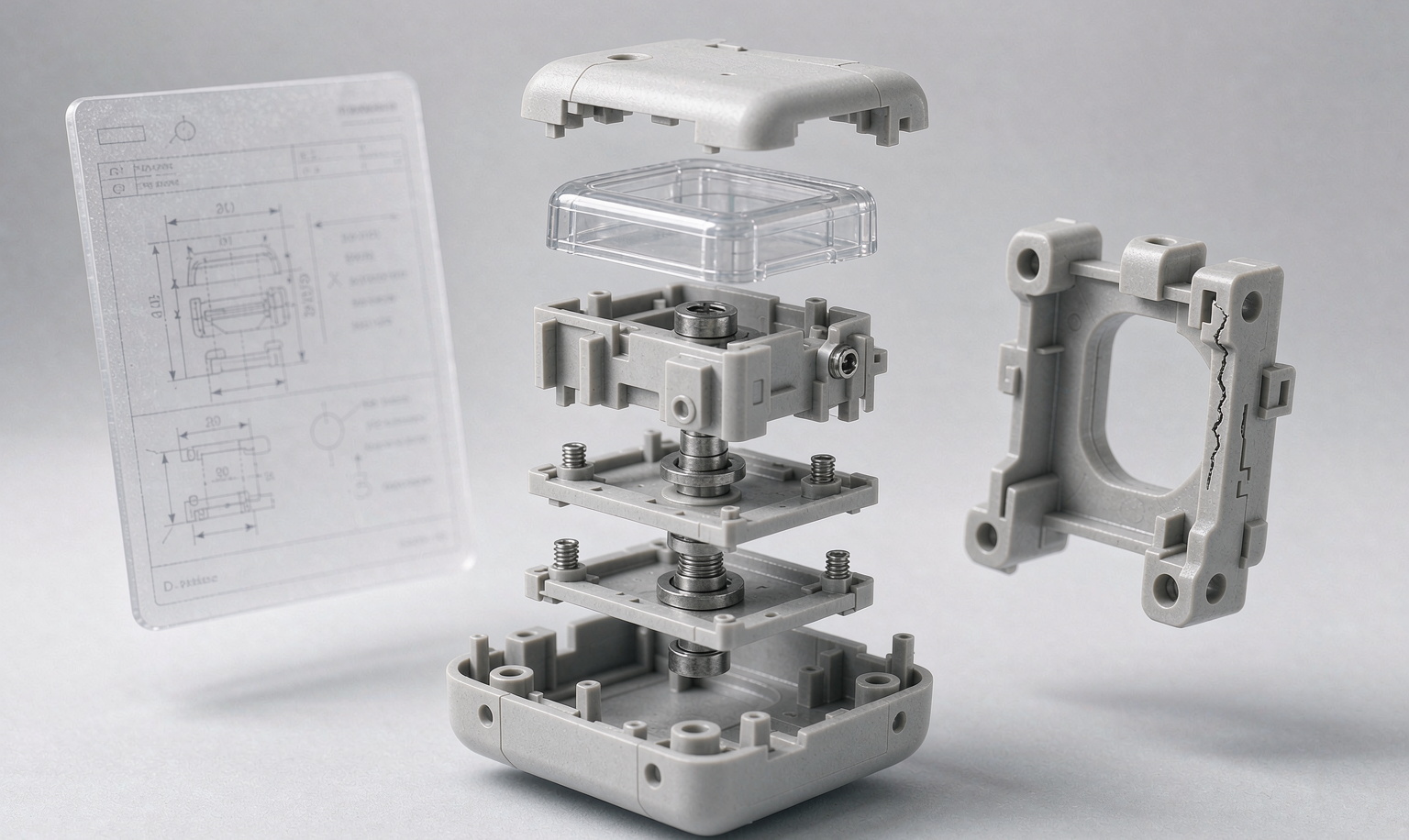
A DFM to production playbook is the sequence of deliberate handoffs that carries a design-for-manufacturing report from a PDF on an engineer's desk into real, repeatable units on the line. The brutal truth: most hardware teams lose the knowledge that matters in the first two handoffs, and they don't find out until the first production run is already in a box.
Daniel found out the hard way.
The 5,000 Units That Almost Shipped Cracked
His team had built a small connected-home sensor puck — a clean industrial design, a sealed enclosure, a snap-fit assembly that felt premium in the hand. The DFM report was done. Tooling was paid: $28,000 for a two-cavity steel mold. The first production run was 5,000 units, already promised to two retail buyers with a hard ship date.
The DFM report had flagged three things we see on nearly every program:
- Snap-fit boss wall thickness: minimum 1.5 mm for the PC/ABS blend he specified.
- Draft angle on the internal bosses: 1.5°, or the parts would stick and scar.
- Material: "PC/ABS" — written with no grade, no melt-flow callout.
None of those three made it to the line intact. The tooling engineer read "min 1.5 mm" as a target he could shave to save steel, and ran the cavity at 1.2 mm. The draft angle was dropped to 0.5° to simplify the lifter. "PC/ABS" stayed undefined, so the molder used the cheapest blend on the shelf. At First Article Inspection, one boss measured 1.2 mm — but the inspection plan's verdict box was ticked "PASS" because the check was cosmetic only.
When Daniel's team ran their own drop test on the FAI samples, 31% cracked on the second drop. We almost shipped 5,000 units that would have failed in a customer's hand within a month.
The DFM report was not wrong. It was simply never transferred. That gap — between a report written by people who leave and a production run kept by people who stay — is what a real DFM to production playbook is built to close.
What 2026 Is Doing to the Handoff Problem
The DFM-to-production handoff is no longer a soft skill. In 2026 it's the single largest source of NPI delay and cost overrun — and the tools that claim to fix it (digital twins, DFM agents) only help if the knowledge crossing each handoff is structured for transfer.
Two things changed this year that make the playbook matter more, not less.
- The "handoff friction" problem is now named explicitly. In March 2026, RapidDirect framed its entire NPI expansion around eliminating "handoff friction" between design, engineering, and production — the silos where a CAD file loses fidelity on its way to a physical assembly. Delta's 2026 digital-twin guidance pushes the same idea further: line-level virtual commissioning moves validation "left" so cross-functional teams validate in a shared virtual environment instead of discovering interference on the physical floor. The industry has stopped pretending the report travels by itself.
- Tariffs turned "design to cost" into a moving target. On October 7, 2026, the USTR confirmed both 2018 China Section 301 actions continue in force. For consumer electronics from China, the effective rate now stacks a 25% Section 301 surcharge on top of the 12.5% Section 301 forced-labor tariff — roughly 37.5% landed before freight and MPF/HMF, with no relief in sight and certain exclusions expiring November 9, 2026. Every tolerance you lose at a handoff quietly blows your cost model; at 37.5%, a 4% BOM miss is no longer a rounding error.
The teams winning in 2026 treat the DFM report not as a document but as a living execution plan with named owners at every seam. That is the playbook. Here is where it actually breaks.
The DFM to Production Playbook: Five Handoffs, Five Places to Lose the Plot
A DFM to production playbook has five handoffs. Each one is a place where a number, a tolerance, or a test can be reinterpreted, dropped, or silently overruled — usually by someone who never saw the original report.
Handoff 1 — DFM Report → Tooling Spec
The tooling engineer receives a PDF, not a conversation. They translate "minimum 1.5 mm" into steel, under cost and schedule pressure, and they make a hundred small calls a day. Daniel's 1.2 mm boss was one of them.
The fix: the DFM report must ship as a resolution matrix — every finding mapped to a CAD change, an accepted risk, or a test, each with an owner and a deadline. No blank rows. We covered the cost logic behind this in design for manufacturing reduce manufacturing costs: 70–80% of unit cost is locked before steel is cut, so the matrix is where that money is either protected or lost.
Handoff 2 — Tooling Spec → Mold Trial (T0 / T1)
T0 is not production; it is the mold maker's opening bid in a negotiation between design intent and process reality. The failure here is treating T0 as "the part" instead of as data. Cycle time, gate vestige, sink, warp — none of it is in the tooling spec; it lives in process parameters nobody wrote down.
The fix: require a dimensional report and a process-parameter sheet at every trial, not just photos. A 45-second quoted cycle that shows up at 72 seconds changes your unit economics before you've shipped a unit.
Handoff 3 — Trial Samples → First Article Inspection (FAI)
This is where Daniel's program died. The FAI measured the boss at 1.2 mm and still passed, because the inspection plan checked cosmetics, not the DFM tolerance. FAI is the moment someone officially says "this is good" — and too often the person saying it has never read the DFM report.
The fix: the FAI acceptance criteria must be derived from the DFM report, not a generic template. Write the inspection brief from the product's failure modes, before the samples arrive.
Handoff 4 — FAI → Pilot Run (200–500 units)
A pilot is the first time the product is made the way it will be made forever — by line workers, on a schedule, with real material lots. Prototypes were made by the engineer who knows every quirk. The pilot is made by someone who doesn't.
The fix: lock the process window (temperature, pressure, cycle) from the trial, build a short SOP, and run the pilot at the real cadence. If yield is below target at 200 units, it will be below target at 5,000.
Handoff 5 — Pilot → Mass-Production Ramp
The last handoff is the SOP that nobody wrote. Without it, every new shift re-derives the process from memory, and defect rates on early batches run 2–3× the stabilized rate.
The fix: a run report that captures actual cost, yield by defect category, the process parameters that worked, and supplier scorecards. It is worth more than the original design file.
Across our recent programs at SciPure, roughly two-thirds of first production runs hit a defect the DFM report had already flagged but never transferred to the line. The report did its job. The handoffs didn't.
If You Are X, Hold the Line at Y: The Handoff Decision Tree
Spend your engineering attention where the handoff is weakest for your situation — not where the report looks most complete.
Stop asking "is the report done?" Start asking "who owns the next seam?"
- If you are a first-time founder with a finished CAD file → do not let the factory own the DFM-to-tooling handoff alone. Insist on a resolution matrix with owners before any steel is cut. This is also where how to reduce manufacturing cost before tooling pays for itself: the same matrix that protects quality protects your BOM.
- If you are a serial entrepreneur reusing a past mold → the danger is complacency at Handoff 3. Your old FAI plan does not know your new material grade. Rewrite the inspection brief.
- If your product has a safety-critical joint or seal → require 100% end-of-line verification with SPC records, not AQL sampling, at Handoff 4. Sampling cannot protect you from a low-frequency, high-severity failure.
- If you sell into the US and your BOM crosses the China border → price the landed cost at 37.5% and re-run the model after every tolerance you lose at a handoff. The target moves; your playbook has to track it.
- If you are adopting a digital twin or DFM agent → feed it the resolution matrix, not the raw PDF. AI amplifies whatever crosses the handoff; it does not invent the missing owner.
For how all five handoffs sit on the calendar, see the average timeline prototype to mass production — the playbook is useless if the handoffs don't have dates.
How Do Tariffs in 2026 Change the DFM to Production Playbook?
2026 tariffs make the cost handoff non-negotiable. Every tolerance lost in translation is a 37.5% tax event waiting to happen, so the playbook has to carry a live landed-cost model, not a static one.
Before the October 7 USTR continuation, some teams treated "design to cost" as a one-time exercise at DFM sign-off. That is no longer safe. When the effective rate on Chinese electronics sits near 37.5% and specific exclusions expire in November 2026, a BOM that was marginal at 25% becomes unviable at 37.5%. The playbook's answer is simple: the resolution matrix should carry a per-finding cost impact, and the cost model should be re-closed at every handoff. A tolerance you "save" at Handoff 1 and lose at Handoff 3 doesn't just risk a crack in the field — it risks a product that can't clear margin at the dock.
The Principle
A DFM report is a promise written by people who leave. Production is kept by people who stay. The playbook is what survives the translation.
The old saying in the building was: a print is only as good as the last hand that read it. In 2026, with tariffs moving and digital tools accelerating everything except accountability, that last hand is a process, not a person. Build the handoffs, name the owners, and the first production run stops being a gamble.
At SciPure Tech (溯朴科技) in Shenzhen, our founder came out of the Foxconn-Apple joint lab with roughly two decades of carrying consumer-electronics and home products from whiteboard to mass production. We hold 29 granted patents, and our founder was named a Shenzhen science-and-technology leadership talent in 2020. We are a product engineering advisor for consumer-electronics and home brands, managing the full journey from concept design to mass production — DFM optimization, injection molding, electronics assembly, QC systems, and supply chain development. That work runs on our own 2,000 m² production facility in Shenzhen's Guangming District (海鑫光高科技工业园), ISO 9001 certified, with IQC/IPQC/FQC/OQC full-process inspection and an AQL 1.0 outgoing standard — tighter than the AQL 2.5 most consumer-goods importers default to. We have capacity; what we sell is engineering judgment. Clients can build on our lines or take the design package back to their own factory — the engagement holds either way. You can see the full program context at www.scipure.net.
FAQ
What should a DFM to production playbook include?
A DFM to production playbook should include a resolution matrix that maps every DFM finding to a CAD change, an accepted risk, or a test — each with a named owner and a deadline; a tooling-spec handoff that carries the matrix into steel; a trial process-parameter sheet (cycle time, gate, sink, warp) at every T0/T1; an FAI acceptance plan derived from the DFM report's failure modes, not a generic template; a pilot-run SOP locked from the trial process window; and a mass-production run report capturing actual cost, yield by defect, and supplier scorecards. The playbook is the transfer mechanism, not the report itself.
How early should the production team see the DFM report?
The production and tooling teams should see the DFM report before steel is cut, not at First Article Inspection. The cost and quality leverage sits at Handoff 1 (report → tooling): pre-tooling changes cost nothing in steel dollars, while post-T0 rework runs $3,000–$8,000 and FAI-stage fixes can reach $30,000–$67,000 per the programs we have run. Inspecting a report you never transferred is how 31% of a run ends up failing a field test it passed on paper.
What is the difference between a DFM report and a DFM to production playbook?
A DFM report is a static document listing what is hard or risky to manufacture. A DFM to production playbook is the sequence of owned handoffs that carries that report into real units — it answers who translates each finding, who approves each trial, who signs the FAI, and who writes the SOP. Roughly two-thirds of first production runs we see hit a defect the DFM report already flagged but never transferred; the report did its job, the playbook didn't.
How does AI or a digital twin help the DFM-to-production handoff?
AI and digital twins help only when the knowledge crossing each handoff is structured for transfer. A DFM agent or line-level virtual commissioning (Delta, 2026) can predict weld lines, shrinkage, and interference before steel is cut, and compress NPI lead time — but it amplifies whatever feeds it. If you hand it a raw PDF with blank owner rows, it optimizes a gap. Feed it the resolution matrix with named owners, and "first-time-right" NPI actually arrives at the line.
How do 2026 tariffs change the DFM to production playbook?
2026 tariffs make the cost handoff non-negotiable. With the USTR's October 7 continuation holding Section 301 at 25% plus a 12.5% forced-labor surcharge (~37.5% effective on Chinese electronics) and some exclusions expiring November 9, 2026, every tolerance lost in translation becomes a margin event at the dock. The playbook should carry a per-finding cost impact and re-close the landed-cost model at every handoff, not just at DFM sign-off.
If you have a product concept and want to know if it's manufacturable, send a written brief at www.scipure.net/inquiry.html. We'll review your design and tell you exactly where the risks are.