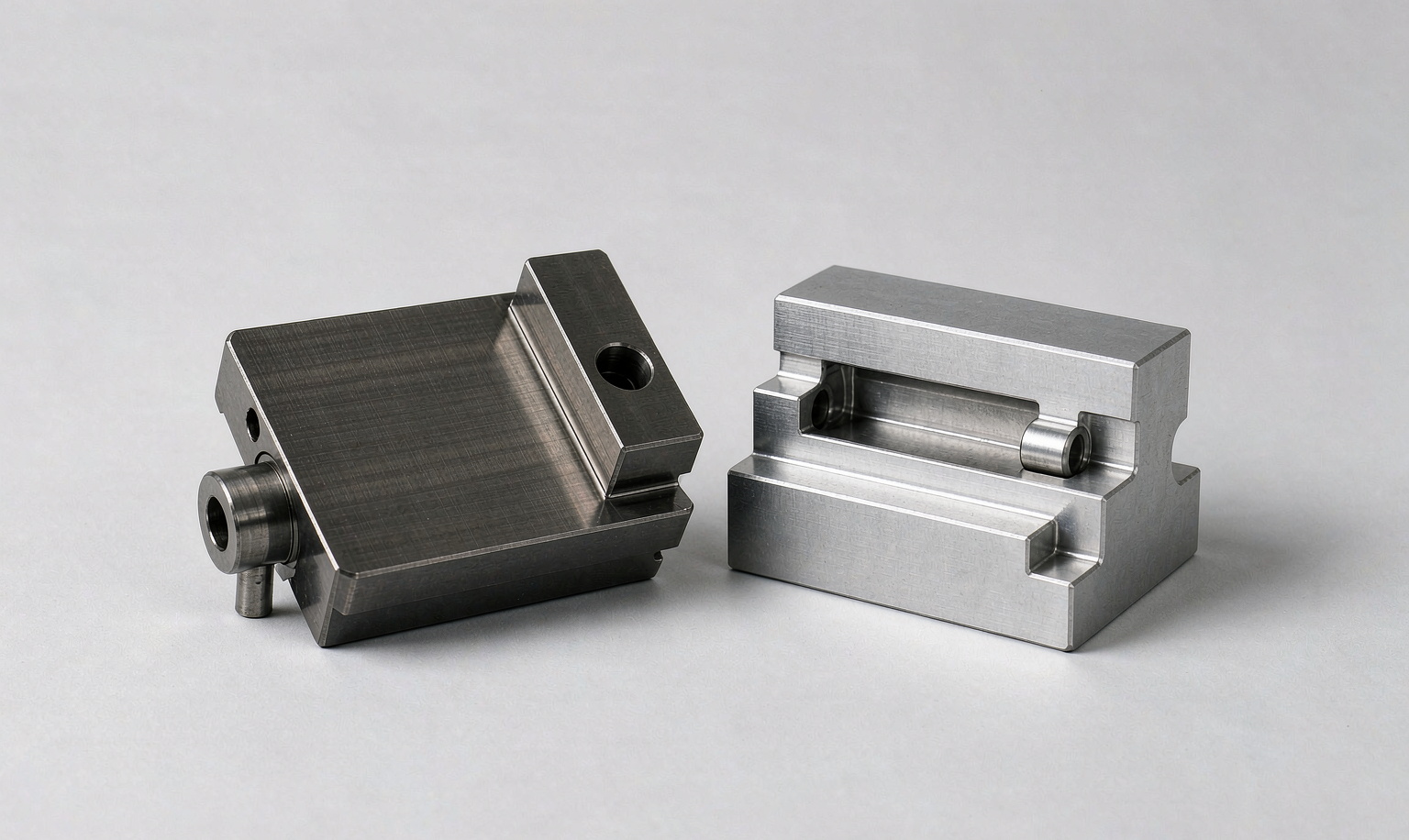
A DFM review before tooling is the structured engineering pass that happens after your CAD is frozen but before a single dollar of mold steel is committed — the last moment in a hardware program when a geometry change costs nothing, and every change after it is measured in thousands of dollars and lost weeks. Get these decisions wrong and you do not just overspend on the tool; you lock a unit cost your product cannot survive.
Maya almost did exactly that.
The Three Quotes That Weren't the Same Tool
Maya's company makes a small connected sleep trainer for toddlers — a soft-glow PC/ABS enclosure, a speaker, a PCB, a silicone button. She had raised a $1.1M seed round and her BOM said 60,000 units in year one. Her factory candidates came back with three quotes for "the same tool":
- $5,900 — a single-cavity aluminum soft tool, 5,000-shot warranty, 12-day build.
- $14,800 — a 4-cavity P20 steel tool, 250,000-shot warranty, T1 samples included.
- $41,000 — an 8-cavity H13 hardened tool with a hot runner and a Class-A polished surface.
She was, understandably, panicked. The spread was almost 7x. The cheapest quote looked like a $35,000 saving. The most expensive looked like someone padding a number.
Here's the thing: none of those three quotes were for the same tool. They were three different bets on her volume, her risk, and her launch date. The $5,900 aluminum tool would have been worn out by part 5,000 — a tenth of her year-one plan. The $41,000 H13 tool was over-spec'd for a first production run she hadn't validated yet. Only the middle quote fit the actual program.
Look, we get it. You see three numbers and your instinct is to sort by price. But a mold quote is not a price for a thing — it is a capital plan for a volume you have not proven. That distinction is the entire topic.
At SciPure Tech (溯朴科技) in Shenzhen, our founder came out of the Foxconn-Apple joint lab — roughly two decades of carrying consumer-electronics and home products from whiteboard to tens of millions of identical units. We hold 29 granted patents, and our founder was named a Shenzhen science-and-technology leadership talent in 2020. We are a Shenzhen-based product engineering advisor that helps consumer-electronics and home brands manage the full journey from concept design to mass production — DFM optimization, injection molding, electronics assembly, QC systems, and supply chain development. That work runs on our own 2,000 m² production facility in Shenzhen's Guangming District (海鑫光高科技工业园), ISO 9001 certified, with IQC/IPQC/FQC/OQC full-process inspection and an AQL 1.0 outgoing standard. We have capacity; what we sell is engineering judgment. A client can build on our lines or take the design package back to their own factory — the engagement holds either way.
Maya didn't have a quoting problem. She had a decision problem, and she was trying to solve it with a spreadsheet before she'd made the five calls that actually mattered.
Why Three Quotes for "the Same Tool" Were Three Different Tools
A mold quote is defined by five engineering decisions. If you haven't made those decisions, every supplier fills them in differently — usually in their own favor. That's why the same CAD returns quotes that differ by 7x.
The 2026 pricing data makes the spread concrete. Based on roughly 800 tooling quotes benchmarked by XY Machining and the 2026 injection-molding pricing report from Jaycon, the real ranges for a small consumer part look like this:
- Aluminum 7075 (SPI Class 105): $1,500–$8,000, 2–3 weeks build. Best for bridge runs under ~10,000 shots.
- P20 pre-hardened steel (SPI Class 104): $8,000–$25,000, 4–6 weeks. The 10K–50K-unit workhorse.
- H13 hardened steel (SPI Class 101): $25,000–$150,000+, 6–14 weeks. For 250K–1M+ units and cosmetic Class-A surfaces.
- Family / multi-cavity H13: $80,000–$200,000+. Consolidates several parts into one tool.
Notice what is not in those ranges: the cavity count, the surface finish, the hot runner, the warranty, the included rework. Those are the silent multipliers. A $4,000 mold quote from a bare-bones shop routinely becomes $6,200 by the time it lands on your floor once you add mold design ($500–$2,000), mold-flow analysis ($300–$800), and freight plus customs ($400–$1,200), based on 300+ China mold projects tracked by VerifyCasting in 2026.
The brutal truth is this: the cheapest quote is usually the one that forgot the most. A DFM review before tooling is how you force every supplier to quote the same tool — so you're finally comparing prices for the same thing.
How Much Can a DFM Review Before Tooling Actually Save?
Run a DFM review before tooling and you'll typically move landed tooling cost by 30–80% on a consumer part. It's the single highest-leverage hour in the program — because the decision is still reversible.
Xinyang Manufacturing's 2026 data isolates the five DFM decisions that swing tool cost most:
- Draft angle: specifying 0.5° draft instead of 2–3° adds $800–$2,500 to tool cost because near-vertical walls machine slower and need EDM.
- Wall thickness and ribs: a uniform wall that avoids thick sections removes sink-mark tooling fixes.
- Parting line and shutoffs: every extra undercut is a slide, lifter, or insert — each a few thousand dollars.
- Tolerance strategy: drawing a worst-case stack instead of nominal ±0.1 mm avoids a re-cut after sampling.
- Gate and ejection plan: a clean gate location is the difference between a tool that runs and a tool that needs a second sampling.
But the bigger lever is cavity count, and most founders get it backwards. Here is the per-part math on a 50,000-unit run from the same 2026 dataset:
- Single-cavity P20: ~$8,000 tool + $20,000 machine time = $28,000 total (≈$0.56/part).
- 4-cavity P20: ~$20,000 tool + $6,900 machine time = $26,900 total (≈$0.54/part).
At 50K the 4-cavity tool is barely cheaper — a trap that burns people who over-spec early. Now push the volume to 250,000 units:
- Single-cavity: $108,000 ($0.43/part).
- 4-cavity: $54,500 ($0.22/part) — a 2x cost difference.
Cavity count only pays off above a clear volume threshold, and that threshold is project-specific. A DFM review is where you compute it instead of guessing it.
The smartest move we put in front of Maya was a two-stage tooling strategy: an aluminum bridge tool for launch, built in parallel with the P20 production tool. The data from Layer X (2026) is unambiguous — that sequence:
- reduces total program tooling cost by 15–25% versus going straight to steel;
- compresses time to first molded part by 6–8 weeks;
- lets you validate gate locations, cooling layout, and ejection on real parts before committing $20K+ to hardened steel.
For a Kickstarter-scale launch expecting under 15,000 units in the first 12 months, aluminum is almost always the right first tool. The tool cost is 40–60% lower than steel, the build is 30–45% faster, and if the design needs a revision after first shipment it is dramatically cheaper to cut. If the campaign succeeds, transitioning to P20 while the aluminum tool keeps producing gives a 6–10 week bridge with no production gap. The reverse — starting in steel and discovering the design needs a change — usually writes off the original tool.
We walked the cost-reduction side of this in our piece on design for manufacturing reduce manufacturing costs, and the volume crossover question in 3D printing vs injection molding cost. This article is the decision layer that sits on top of both.
If You Are X, Choose Y: The Pre-Tooling Decision Tree
Stop sorting quotes by price. Sort them by program. Use this tree — it is the output of a DFM review before tooling, written as a choice, not a table.
- If you are under 15,000 units in year one and the design is still moving → choose an aluminum bridge tool. Lowest cash outlay, fastest to first part, cheapest to revise. Accept the 5,000–20,000-shot life limit; that is the whole point.
- If you are at 15,000–100,000 units and the geometry is frozen → choose a 2–4 cavity P20 tool. The 10K–50K workhorse; 250,000-shot warranty covers your first two years.
- If you are above 250,000 units or need a Class-A cosmetic surface → choose H13 hardened steel, multi-cavity, with a hot runner. The upfront cost is real, but per-part cost halves versus single-cavity.
- If your launch date is before your production tool can be ready → choose both: aluminum bridge now, steel in parallel. Buy the 6–8 weeks, not the false economy.
- If your part is glass-filled or corrosive (GF nylon, PVC, mineral fill) → choose P20 or H13 with steel inserts at minimum. Aluminum wears 3–5x faster on abrasive resins and will not hold tolerance.
That last branch is the one founders skip and regret. Aluminum is a great bridge tool for unfilled polymers; for a glass-filled housing it is a false saving that surfaces as drift by part 5,000.
The 2026 Tariff Math Changed Where the Tool Should Live
In 2026, a Chinese production mold landing in the US carries a combined duty of roughly 48% — so "where you cut the steel" is now a tariff decision, not just a freight one.
This is the dimension most 2025 playbooks missed. MoldMinds' 2026 analysis puts the combined rate on HTS 8480.71.9000 (injection molds for rubber/plastics) at about 48.1%: a 3.1% base MFN rate, plus the 25% Section 301 List 3 add-on, plus the 20% executive-order duties layered on in early 2025. PreciseWorks+ shows the same band — a $50,000 Shenzhen mold becomes ~$73,000 at US customs.
The workaround most US-bound programs now use is the Mexico IMMEX route: the tool sails to a Mexican plant, enters as temporary production equipment under IMMEX, and the 25% Section 301 tariff never attaches because it never enters US commerce. On a $40,000 tool that is the difference between +$10,000 and +$0 in duty. The USMCA joint review that opened July 1, 2026 is tightening scrutiny of Chinese content, so documentation discipline is no longer optional hygiene — but a genuine mold making transformed parts is manufacturing, not transshipment, and qualifies.
Meanwhile steel itself is more expensive: hot-rolled coil averaged $720/ton in Q4 2025 versus a $580 pre-tariff baseline (Manufacturing Mag, 2026), and import safety stock for tariff-exposed parts has stretched to 90–120 days. None of this changes the fundamental rule — China tooling is still cheap at the bench — but it absolutely changes your landed cost model, and your DFM review before tooling is where that model gets built.
One more 2026 shift worth noting: AI-assisted RFQ tools (MoldMinds, among others) have pulled tooling quote turnaround from 2–3 weeks to 3–5 days. Faster quotes are good; they also make it easier to collect seven quotes that still aren't comparable. The discipline hasn't changed — make the five decisions first. If you want the full clock those decisions sit on, read the average timeline prototype to mass production.
What the Mold Quote Should Contain Before You Sign
A mold quote you can actually act on has five things beyond a number and a lead time. Miss any one of them, and it's a quote you shouldn't sign.
- A written warranty by shot count. Aluminum: ~5,000 shots. P20: ~250,000 shots. H13: 1M+. No warranty, no signature.
- T1 dimensional reports on at least 5 sample parts against your drawing, with critical-to-quality features flagged. A supplier who won't commit to written T1 documentation will not own drift at part 5,000.
- An itemized tool cost, not a lump sum — steel grade, cavity count, hot runner, surface finish, and mold base each on its own line.
- A spares kit. We have watched a line sit idle for three weeks waiting on a $200 ejector component that should have shipped with the mold.
- A defined engineering-change cost. Minor dimensional tweaks run $400–$1,500; adding a feature or moving a gate runs $2,000–$6,000. Know this before you issue the PO, because you will issue one.
And require the DFM report that produced the tool. A real design-for-manufacturing review covers gate locations, draft angles, wall-thickness flags, and an ejection plan. A supplier who sends one is a supplier who answers the phone in month eighteen. We wrote up the broader pre-tooling saving in how to reduce manufacturing cost before tooling — it remains the highest-leverage hour in most hardware programs.
The Principle
A mold is frozen money. Amortize it before you cast it.
The corollary we repeat to every founder: the most expensive tool is the one you have to rebuild, and the cheapest tool is the one you never had to. Price is what you pay for the steel; the decision is what you pay for the program. Make the five calls — material, cavity count, surface, warranty, and where the steel gets cut — and the quote stops being a mystery and starts being a plan.
The old shop saying fits: measure twice, cut once. In injection molding, the cutting costs $5,000 to $50,000, and you only get to measure before the steel goes in the machine.
FAQ
How do I reduce manufacturing cost before tooling?
Run a DFM review before tooling that locks five decisions: tool material (aluminum bridge, P20, or H13), cavity count matched to your proven volume, surface finish, warranty by shot count, and where the steel is cut given 2026 tariff exposure. On a typical consumer part these decisions swing tooling cost 30–80%, and a two-stage aluminum-bridge-plus-steel strategy reduces total program tooling cost 15–25% while compressing time to first part by 6–8 weeks. Every change is free until the steel is committed; after that it costs thousands.
What is a DFM review before tooling and what should it contain?
A DFM review before tooling is the engineering pass after CAD is frozen but before mold steel is cut. It should contain a per-part feasibility assessment, a worst-case tolerance stack for every snap-fit and press fit, a resolved assembly sequence with cycle-time estimates, a tooling recommendation (material, cavity count, surface, warranty), a tariff-aware landed-cost model, and a costed change list split into must-do-before-tooling and can-defer. If a report only says "manufacturable, no major issues," it has not been done.
Should I use aluminum or steel tooling for my first production run?
For under 15,000 units in year one, or any program where the design is still moving, aluminum bridge tooling is almost always right: 40–60% lower tool cost, 30–45% faster build, and far cheaper to revise. Above 250,000 units or for a Class-A cosmetic surface, H13 hardened steel wins on per-part cost. Between 15,000 and 100,000 units with frozen geometry, a 2–4 cavity P20 tool is the workhorse. For glass-filled or corrosive resins, use steel inserts regardless of volume.
How many cavities should my first injection mold have?
Match cavity count to proven volume, not hope. At 50,000 units a 4-cavity tool is only marginally cheaper per part than single-cavity; at 250,000 units it is roughly half the per-part cost. Over-specifying cavities on an unvalidated product wastes $10K–$40K of tool steel you may rebuild. Start with the cavity count your validated demand supports, and add cavities when volume is proven — not before.
How much does an injection mold cost in 2026 and how do tariffs affect it?
A small consumer part runs roughly $1,500–$8,000 in aluminum, $8,000–$25,000 in P20, and $25,000–$150,000+ in H13, before adding design, mold-flow, freight, and customs. In 2026 a Chinese production mold landing in the US carries about 48% combined duty (MFN + Section 301 + executive-order), so a $50,000 tool becomes ~$73,000 at customs. The Mexico IMMEX temporary-import route avoids the Section 301 tariff entirely. Build the landed cost into your DFM review before tooling, not after the PO.
If you have a product concept and want to know if it's manufacturable, send a written brief at www.scipure.net/inquiry.html. We'll review your design and tell you exactly where the risks are.