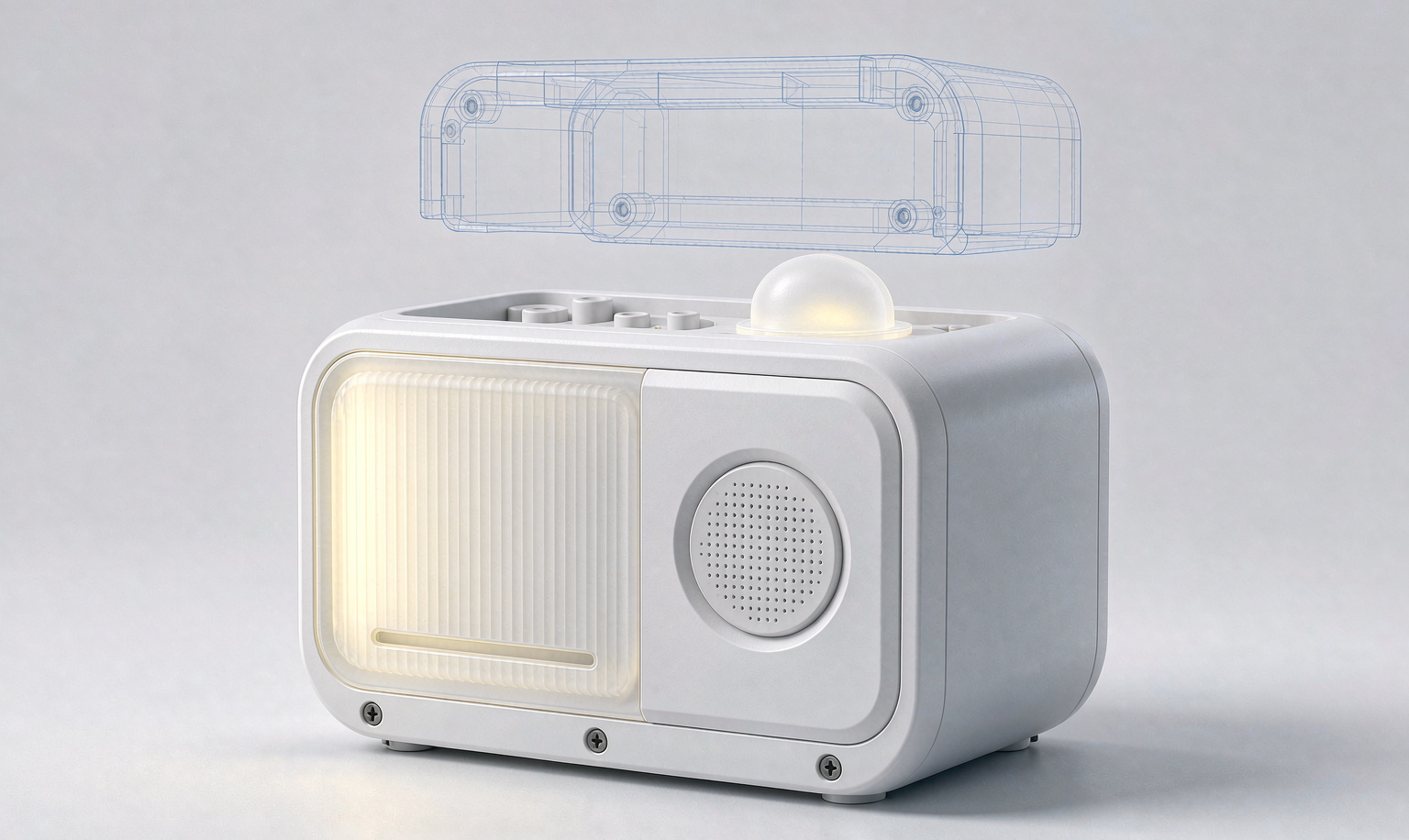
Product idea to manufacturing is the discipline of assigning a manufacturing identity to a concept — material, process, volume, certification, and geography — so it can exist as a repeatable, legal, margin-surviving product instead of a beautiful picture. The distance between the two is not a time gap you close by working harder. It is a knowledge gap — and in 2026, it is wider than it has ever been.
The Rendering That Raised $750K — and Couldn't Be Built
Marcus emailed us a hero render of a smart-home aroma diffuser: a faceted glass-and-aluminum obelisk, warm light bleeding through frosted edges, the kind of image that makes a seed investor lean in. He'd closed a $750K pre-seed on that picture. The prototype in his hand looked almost as good. "We just need to make it," he wrote. "How fast can we tool this?"
The brutal truth arrived in our first DFM call. That beautiful idea had never met manufacturing reality. The "glass" was a single-blow-molded shape that, at his $40 landed target, simply could not exist — real frosted glass at that wall section costs more raw than his whole unit budget. The custom fragrance micro-pump he'd spec'd had a 22-week lead from one supplier in Germany. There was no FCC or CE path drawn anywhere. And the entire plan assumed China-only production, in a year when the tariff stack on Chinese consumer electronics had climbed to roughly 37.5%.
Marcus had a product idea. He did not yet have a product. The gap between those two is not a time gap you close by working harder — it's a knowledge gap, and in 2026 it is wider than it has ever been.
What 2026 Did to the Idea-to-Reality Gap
In 2026 the distance between a product idea and a manufacturable product grew, not shrank. Generative design tools now turn out ten times more "concepts" that look production-ready but carry zero manufacturing identity — and new compliance and tariff rules turn geography and software into part of the product itself.
Three shifts changed the math this year:
- The idea supply exploded. Text-to-CAD and generative design lowered the cost of a pretty concept to nearly zero. That's good for creativity and brutal for triage: far more founders now arrive with a render and no clue which material, process, or certification their idea actually requires.
- Accelerators moved the goalposts. Hardware programs including HAX, Lemnos Lab, and Rev: Ithaca now screen for manufacturing readiness — an EMS partnership and a DFM-complete design — as entry criteria, not a post-demo bonus. Y Combinator's current batch includes a record 114+ hardware companies, and accelerator cohorts are expanding 30%+ year over year. The message is uniform: a prototype is no longer proof; a manufacturing plan is.
- Compliance and geography became part of the idea. From September 11, 2026, the EU Cyber Resilience Act mandates active vulnerability reporting, a Software Bill of Materials (SBOM), and secure-over-the-air updates for connected devices. The January 15, 2026 U.S.–Taiwan agreement capped reciprocal tariffs on electronics and semiconductors at 15%. And the "U.S. Plus Two" strategy — U.S. management with manufacturing spanning China plus at least two more regions (Mexico, Vietnam, Indonesia) — is now the default resilience play. Where you make it is no longer a downstream logistics decision; it's a design decision.
For benchmarking speed, agile partners now quote compressed windows: functional prototypes in 2–3 weeks, production-ready samples in 30–45 days, mass-production launch in 60–90 days — but only for products whose five identities are already assigned. The speed is real. It is also conditional.
The 5 Manufacturing Identities Your Sketch Forgets
A product idea is a free hypothesis. A product is a set of five assigned manufacturing identities — and most sketches arrive with all five blank.
When Marcus came to us, his render implied a product but specified none of these. Neither does yours, until you assign them on purpose.
1. Material identity. What it's actually made of, down to the grade. "Glass" in a render can mean borosilicate, soda-lime, or — more honestly — a two-shot molded PC/ABS shell that reads as glass. The grade carries melt-flow, impact, and cost consequences that decide whether the unit is $4 or $40. We covered the cost logic in design for manufacturing reduce manufacturing costs: 70–80% of unit cost is locked before steel is cut, and material identity is where it gets locked.
2. Process identity. How it's made — injection molding, CNC, die-cast, or 3D printing — and the minimum order that process demands. A founder who says "just make it" has skipped the single biggest cost-and-speed lever in the program. The 3D printing vs injection molding cost crossover is not a technology debate; it is a volume decision, and your process identity is the answer.
3. Volume identity. At what quantity the economics actually work. The same part can be rational at 200 units (bridge molded) and irrational at 200,000 (wrong resin choice). Volume identity sets your break-even and your tooling strategy before you quote a single cavity.
4. Certification identity. What the product must clear to be legal and insurable: FCC, CE, UN38.3 for any lithium cell, and — new in 2026 — EU CRA security reporting for anything connected. Founders routinely treat certification as a post-script. It is a design constraint that shapes the board, the firmware, and the bill of materials from week one.
5. Geography identity. Where it's made and what tariff stack that triggers. A Shenzhen-only plan and a Taiwan-assembly-plus-China-components plan can differ by double-digit percentages on landed cost in 2026, and only one of them survives a customs audit under the new forced-labor tracing rules.
Assign all five and your "idea" becomes a product someone can actually buy. Leave one blank and it becomes a story you tell investors.
If You Are X, Assign Y: The Idea-to-Reality Decision Tree
Your right next step depends entirely on which identities your concept already has — not on how excited you are about the render.
- If you have a napkin sketch → do not ask for a tooling quote. Assign material and process identity first through a design-for-assembly review. A sketch with no material call is a wish, not a spec.
- If you have CAD but no sourcing plan → run a DFM pass and build a bottom-up should-cost before you fall in love with the shape. The how to reduce manufacturing cost before tooling moment is earlier than founders think, and it's the last free decision in the program.
- If you have a working prototype → your gap is almost always identity #4 and #5 (certification and geography), not #1–#3. The thing works; it just can't legally or economically cross a border yet.
- If you're building a connected or IoT device → EU CRA, SBOM, and FOTA are now part of "manufacturing reality" from day one, not a launch-week scramble. Design the security architecture before the enclosure.
- If you sell into the U.S. → compute landed cost at the 2026 tariff stack (roughly 37.5% on Chinese electronics before freight) before you commit to a geography identity. The number decides whether the idea survives contact with a margin sheet.
For how these identities sit on a calendar, see the average timeline prototype to mass production — assigning identities early is what keeps that timeline from slipping.
How Do You Turn a Product Idea Into a Manufacturable Design?
You turn an idea into a manufacturable design by resolving the five identities in a concept-and-feasibility sprint — usually weeks one and two — not at the tooling stage, where every change costs roughly ten times more.
Our internal records and OPD Design's 2026 DFM data agree on the curve: a fix made during CAD modeling costs 1×; the same fix after design freeze costs 4×; after first mold trial (T0), 10–25×; after mass production starts, 50–100×. The diffuser Marcus brought us needed all five identities assigned after he'd already promised investors a ship date — which is why his recovery cost more than his original budget assumed. The founder who assigns identities in week two spends almost nothing to get them right.
A Real Recovery: The Diffuser That Became Three SKUs
Marcus didn't scrap the product. He assigned the five identities on purpose:
- Material: dropped real glass for a two-shot molded PC/ABS shell with an internal light pipe — same premium read, one-tenth the cost.
- Process: replaced the custom 22-week micro-pump with a qualified off-the-shelf module, shifting process identity from "custom molded" to "assembly of catalog parts."
- Volume: set the launch at 3,000 units on bridge tooling, with a steel path pre-approved if the SKU hit 20K.
- Certification: front-loaded FCC and EU CRA security architecture before the enclosure froze.
- Geography: designed in Shenzhen, assembled in Taiwan under the new 15% reciprocal cap for U.S.-bound units, avoiding the full China tariff stack.
Result: 14 weeks to first production units — not the nine months he'd feared, and a BOM that survived the 2026 tariff math instead of drowning in it. The render didn't change. The identities did.
What "Manufacturing Reality" Means at SciPure
At SciPure Tech (溯朴科技) in Shenzhen, our founder came out of the Foxconn-Apple joint laboratory with roughly two decades of carrying consumer-electronics and home products from whiteboard to mass production. We hold 29 granted patents, and our founder was named a Shenzhen science-and-technology leadership talent in 2020. We are a product engineering advisor for consumer-electronics and home brands, managing the full journey from concept design to mass production — DFM optimization, injection molding, electronics assembly, QC systems, and supply chain development. That work runs on our own 2,000 m² production facility in Shenzhen's Guangming District (海鑫光高科技工业园), ISO 9001 certified, with IQC/IPQC/FQC/OQC full-process inspection and an AQL 1.0 outgoing standard — tighter than the AQL 2.5 most importers default to. We have capacity; what we sell is engineering judgment. Clients can build on our lines or take the design package back to their own factory — the engagement holds either way. You can see the full program context at www.scipure.net.
FAQ
What is the difference between a product idea and a manufacturable product?
A product idea is a free hypothesis — a sketch, a render, or a prototype that proves the concept can exist once. A manufacturable product is that same idea with five manufacturing identities assigned: material, process, volume, certification, and geography. Until those are resolved, the concept cannot be built repeatedly, legally, and at a margin that lets the company survive. Most failed launches die at the identity gap, not at the drawing board.
How do you turn a product idea into a manufacturable design?
Turn an idea into a manufacturable design by running a concept-and-feasibility sprint in weeks one and two that assigns all five identities, then validating them through DFM, a should-cost model, and a sourcing plan before any tooling is cut. Changes made during CAD modeling cost 1×; the same change after first mold trial costs 10–25×. Assigning identities early is the single highest-leverage move in product idea to manufacturing.
Why does a great product idea still fail in manufacturing?
A great product idea still fails in manufacturing because the render implies a product without specifying one. The five identities — material grade, process and MOQ, volume economics, certification, and geography — get decided by default under schedule pressure, usually wrong, and the cost of correcting them climbs roughly tenfold at every stage. In 2026, generative design tools and new EU CRA and tariff rules make this trap deeper: more concepts, more compliance, and geography as a design constraint.
When should I start thinking about manufacturing for my product idea?
Start assigning manufacturing identities during concept and feasibility — weeks one and two — not at the tooling stage. A design-for-assembly review and a bottom-up should-cost model at this point are nearly free to change; the same decisions made after T0 cost 10–25× more. The earlier you make manufacturing reality part of the idea, the cheaper every later correction becomes.
How do 2026 tariffs and compliance change product idea to manufacturing?
2026 makes geography and software part of the product itself. The EU Cyber Resilience Act (effective September 11, 2026) requires SBOM and secure updates for connected devices; the U.S.–Taiwan agreement caps electronics tariffs at 15%; and the "U.S. Plus Two" strategy spreads manufacturing across China plus two regions for tariff and risk resilience. Chinese consumer electronics still face roughly 37.5% landed before freight. These rules mean certification and geography identities must be assigned in week two, not at launch.
The Principle
A product idea is a free hypothesis. Manufacturing reality is the experiment that proves or kills it — and the cost of that experiment is set the moment you assign the first identity.
The old line in the building was: anyone can draw a product; few can build one. In 2026, when AI will happily draw you ten thousand products before lunch, the scarce skill is the one Marcus learned the hard way — turning a beloved idea into five boring, unglamorous, life-or-death identities, and assigning them before the clock starts.
If you have a product concept and want to know if it's manufacturable, send a written brief at www.scipure.net/inquiry.html. We'll review your design and tell you exactly where the risks are.