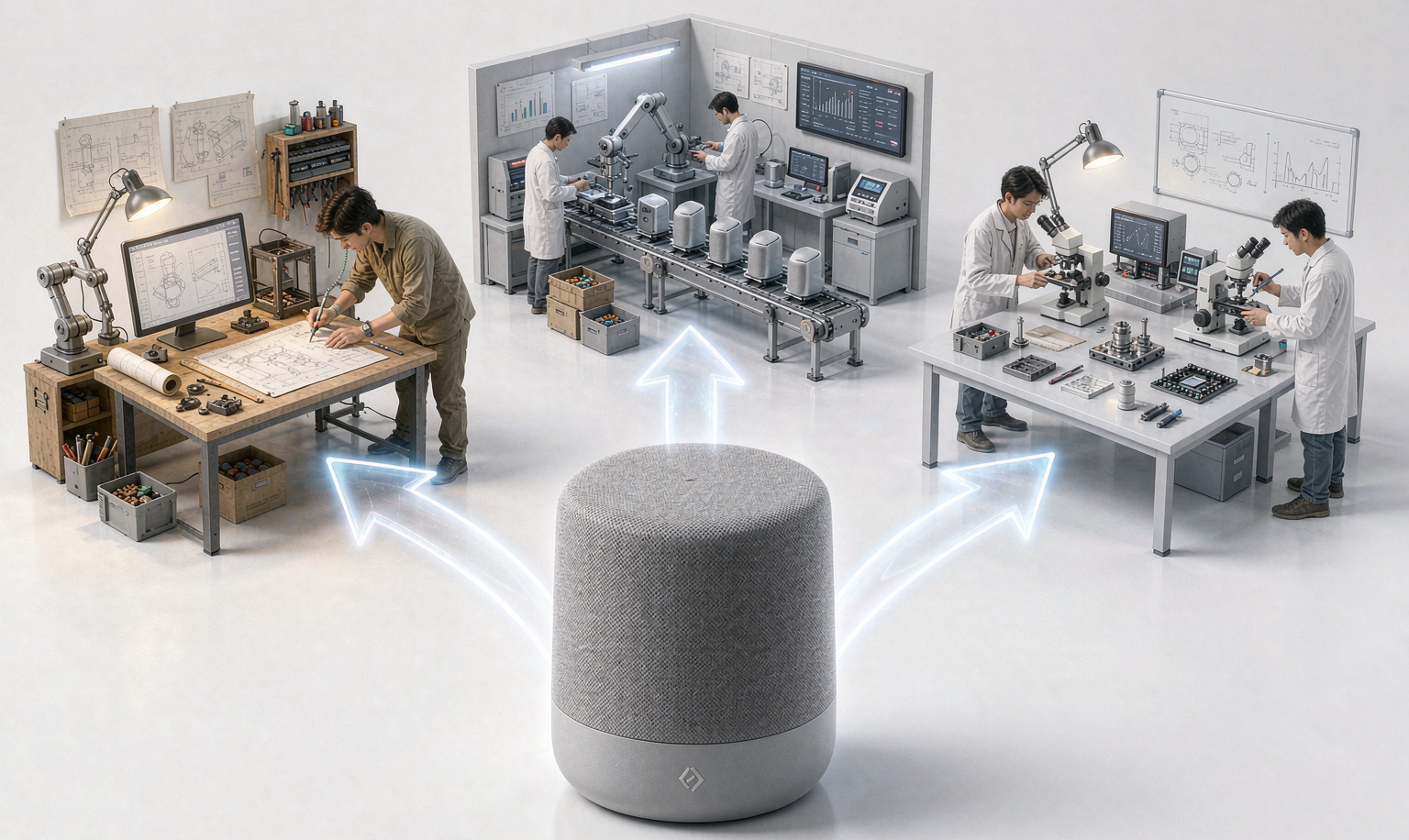
You do not need your own factory to launch a physical product — but you do need to pick the right way to use someone else's. For a retail or consumer brand, there are three real paths: OEM (you own the design, a partner builds it), ODM (your partner designs and builds it), or a product-engineering advisor who can run either model and keep your IP clean. The mistake most brands make is treating all three as "just find a factory" — and that confusion is exactly where 20–40% of margin, or an entire selling season, disappears.
This guide defines the three models in plain terms, shows what each one actually owns and risks, walks through the traps that specifically bite retail brands in 2026 (MOQ, certification, the ~37.5% tariff stack, IP ownership), and gives you a decision tree for picking the right path.
Not sure how long any of these paths take? Use our Concept to Production Timeline Calculator — pick your industry, complexity, and market, get a planning range in 2 minutes. No sign-up.
The three options, defined
1. OEM — you bring the design, a partner builds it
OEM (Original Equipment Manufacturer) means you arrive with finished designs, 3D CAD, and specs; the partner manufactures to your file. Best when you have a real design team and want maximum IP control. You own the product design; the factory owns the tooling it cuts — under Chinese law, mold ownership defaults to whoever designed the mold, not whoever paid for it, unless that is contracted otherwise.
2. ODM — your partner designs and builds it, you brand it
ODM (Original Design Manufacturer) means the partner designs and builds a product you brand and sell. It is the fastest path to shelf when you have a market but no engineering bench. The trade-off: weaker differentiation and shared IP, because the same platform is often sold to every other brand that asks. Exclusivity and design-assignment clauses are where you win that back.
3. Product-engineering partner — the hybrid that leads with judgment
A product-engineering advisor can run OEM or ODM, but leads with engineering judgment — DFM, certification strategy, supplier architecture — and hands you a clean, transferable design package whether you build on their line or take it elsewhere. This is our own model: we operate our own ISO 9001 factory in Shenzhen, but what we sell is engineering judgment, not capacity. Clients can build on our lines, or take the design package to their own factory — the engagement holds either way.
OEM vs ODM vs engineering partner — at a glance
| Dimension | OEM | ODM | Engineering partner |
|---|---|---|---|
| Who owns the design | You | The partner (shared platform) | You (package is transferable) |
| Who owns the tooling | You (per Chinese default) | The partner | You, or assigned to you |
| Speed to shelf | Medium (your design must be production-ready) | Fastest | Medium–fast (depends on starting point) |
| IP risk | Low (if files are protected) | High (shared platform) | Low (clean assignment built in) |
| Best for | Brands with a strong design bench | Brands with a market but no engineering | Brands wanting a defensible product + option to move factories later |
| Added cost vs a bare factory | Engineering / project management | Platform markup | Engineering judgment + optional build |
The five traps that specifically bite retail brands in 2026
1. MOQ mismatch
Factories quote 5,000–10,000-unit MOQs; a new retail brand needs 500–1,000 to test a shelf. This is the single most common reason a good product never launches. Bridge (aluminum) tooling and pilot runs of 50–500 units close the gap — validate the market before committing to steel.
2. Certification is not optional
For electronics: FCC / CE-RED, UN38.3 for any battery, EU GPSR traceability. These are design constraints, not post-scripts. Starting certification evidence at concept — in parallel with industrial design — is the difference of months, and the difference between a product that ships and one that sits in a customs hold.
3. The 2026 tariff stack
Chinese consumer electronics land at roughly 37.5% before freight in 2026. A "U.S. Plus Two" strategy — U.S. management with manufacturing spanning China plus at least two more regions — or a Taiwan-assembly variant under the new 15% reciprocal cap can cut that sharply. Where you make it is now a design decision, not a downstream logistics afterthought.
4. Quality at volume, not at sample
A golden sample proves almost nothing. What proves a product survives volume is a chain of custody over who checks what, with what evidence, traceable to which lot — IQC, IPQC, FQC, OQC at every stage, and an AQL 1.0 outgoing standard (tighter than the AQL 2.5 most importers default to).
5. IP ownership
Under Chinese law, mold ownership defaults to whoever designed the mold, not whoever paid for it. Protect yourself with NNN agreements before any file sharing, CNIPA registration in China before you send CAD, and operational controls on who touches the tool. We cover the mechanics in Your NDA Is Not Protecting Your Design.
How to choose — a decision tree
- You have a finished, protected design and want maximum IP control → OEM. You keep the design; negotiate tooling ownership explicitly.
- You have a market but no engineering bench, and speed beats uniqueness → ODM — but negotiate exclusivity or design assignment up front, or you will be one of ten brands on the same shelf.
- You want a defensible product and the option to move factories later → a product-engineering partner who delivers a transferable design package, not just units.
The principle
In 2026, the scarce skill is not making the product — it is deciding which path, then making the path not trap you. A retail brand that picks OEM/ODM/partner on purpose, front-loads certification, and validates at low volume before steel will out-execute a better-funded competitor that "just found a factory."
Our team brings two decades of Foxconn and Apple-lab engineering experience and 29 granted patents to exactly this decision. We operate our own 2,000 m² Shenzhen facility, but we lead with engineering judgment — so the path you choose is the one that protects your margin, your season, and your IP.
Frequently asked questions
What are the manufacturing options for a retail brand with no factory?
Three: OEM (you bring the design, a partner builds it), ODM (the partner designs and builds it, you brand it), or a product-engineering partner who can run either model and deliver a transferable design package. The right one depends on your design maturity, IP sensitivity, and volume.
OEM vs ODM: which is cheaper and faster?
ODM is usually faster to shelf because the design already exists; OEM can be cheaper per unit at volume because you are not paying a platform markup. But ODM carries higher IP risk and weaker differentiation. "Cheaper" depends on whether you count the cost of a shared, easily-copied product.
Can I keep my IP if I use a Chinese ODM?
Yes, if you structure it: NNN agreements before file sharing, CNIPA registration in China before you send CAD, and an explicit design-assignment clause. Absent those, a Chinese ODM's platform — and the mold — defaults to the designer under Chinese law. An engineering-partner model bakes the clean assignment in.
What MOQ should a new retail brand expect in 2026?
Factories typically quote 5,000–10,000 units, but a new brand can and should start at 500–1,000 via pilot runs or bridge tooling. Insist on a low-volume validation path before committing to hardened steel — it protects both your cash and your season.
How do 2026 tariffs change which manufacturing option I pick?
The ~37.5% China tariff stack on consumer electronics makes geography a design decision. A U.S. Plus Two strategy or Taiwan-assembly variant (15% reciprocal cap) can cut landed cost double digits. Build the tariff math into the option choice at week two, not at launch.