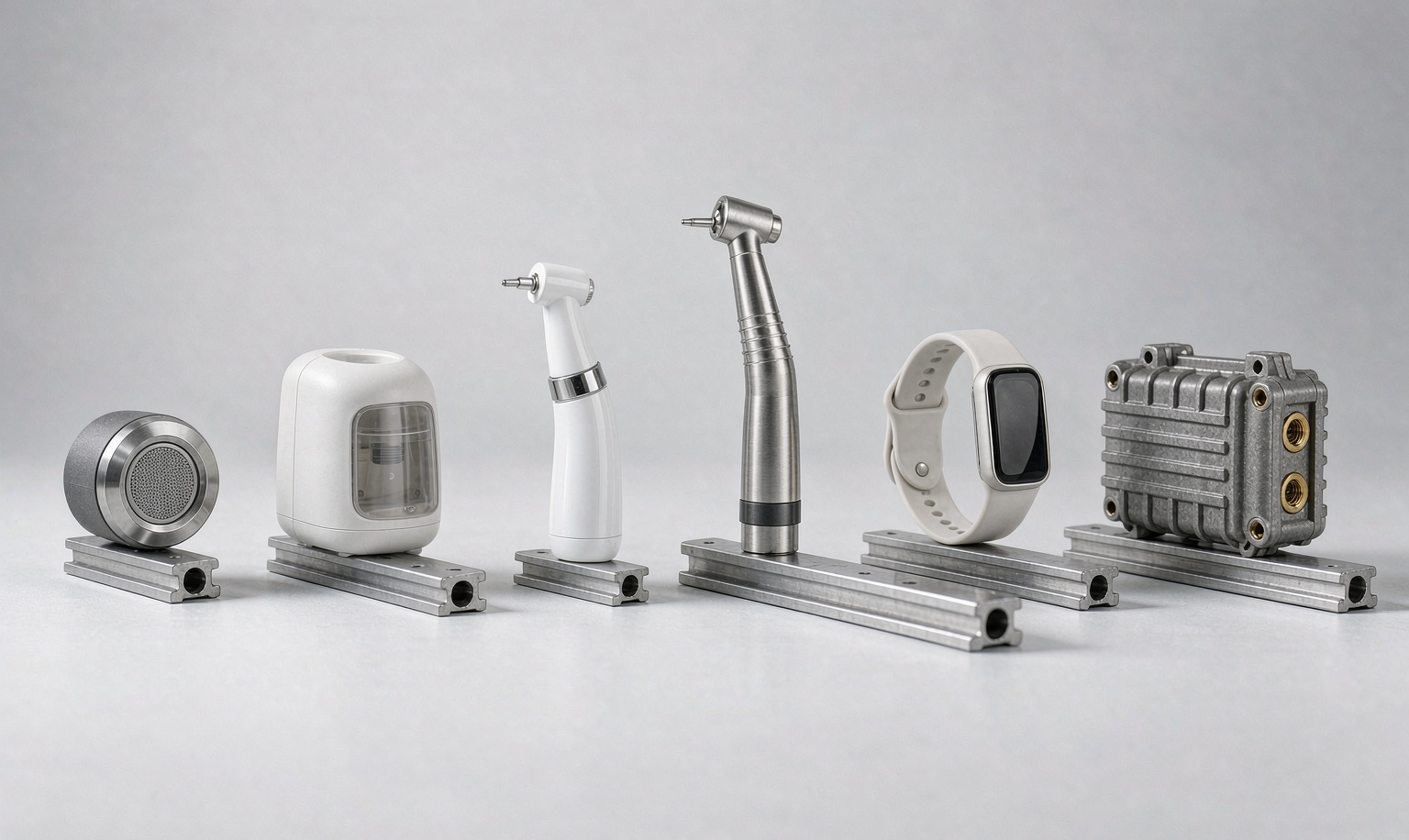
"How long from concept to production?" It is the most-asked question in hardware, and the most misleading to answer with a single number. A simple beauty device and a Class II medical device can both be "consumer products," yet their calendars differ by years, not weeks. The gap is rarely about engineering difficulty — it is about certification, sterile requirements, and how many external reviewers sit between your CAD file and your first shipment.
This article breaks the question down by industry, using 2026 benchmarks from real programs we have run — consumer electronics, home appliances, beauty & personal-care devices, dental/medical devices, IoT & wearables, and industrial/outdoor products. At the end is a table you can screenshot and bring to your next planning meeting.
Want your own number, not an industry average? Use our Concept to Production Timeline Calculator — pick your industry, complexity, and market, get a planning range in 2 minutes. No sign-up.
Why "by industry" matters more than "by complexity"
Founders often assume timeline scales with how clever the product is. It does not. Two products of near-identical mechanical complexity — say, a USB-C desk fan and a CPAP humidifier chamber — land in wildly different timelines because one needs nothing more than a basic electrical safety mark, while the other needs biocompatibility testing, sterile packaging validation, and a notified-body review.
The single biggest timeline driver across every industry below is the same one we flagged in our prototype-to-production guide: the DVT → PVT transition, where a design gets frozen and tooling gets cut. Everything before it is flexible; everything after it is expensive to change. Industry only changes how long DVT takes and what evidence DVT must produce.
The 2026 industry comparison
All ranges are calendar time from a frozen concept (design brief signed off) to first mass-production shipment. They assume a competent engineering partner handling DFM, project management, and supplier coordination — going fully DIY with disconnected vendors typically adds 30–60% to each range.
| Industry / Product type | Typical concept → production | What stretches it | Certification driver |
|---|---|---|---|
| Consumer electronics (gadgets, smart-home, audio) |
3–6 months | Custom PCB + firmware loops, RF tuning, battery safety | FCC / CE-RED, UN38.3 (battery), RoHS |
| Home appliances (small kitchen, air care) |
4–8 months | Motor/thermal validation, mold count, safety interlocks | UL / CE-LVD, ERP energy labeling |
| Beauty & personal-care devices (skincare tools, misters) |
3–5 months | Material skin-contact validation, packaging claims | FDA cosmetic / EU GPSR, REACH |
| Dental & medical devices (handpieces, delivery tips) |
9–18 months | Biocompatibility, sterile barrier validation, audit | FDA 510(k) / EU MDR, ISO 13485 |
| IoT & wearables (trackers, sensors) |
4–9 months | Wireless certification, app-store review, antenna | FCC / CE-RED, BLE SIG, platform review |
| Industrial / outdoor (tools, enclosures) |
5–10 months | Environmental rating, ruggedization, low-volume tooling | IP rating, CE-MD, material traceability |
Note: ranges reflect 2026 realities — tariff volatility, component price swings from the AI-chip boom, and tighter EU GPSR traceability all push the upper bound. A rush program can compress the lower bound by ~30% at a 20–40% cost premium.
Three industries worth a closer look
1. Consumer electronics — fast, but unforgiving on DVT
This is the category with the shortest clock and the highest failure rate at the DVT→PVT wall. The trap is not the engineering — it is the silent assumptions: a battery that passes at room temperature but sags at 45°C, firmware that works on the dev board but not on the production MCU, an RF antenna that radiates fine until it sits inside the enclosure. Each one is cheap to fix in CAD and brutal to fix after steel. The 3–6 month window is achievable only if DVT is treated as a gate, not a formality.
2. Beauty & personal-care devices — deceptively quick
Many founders over-budget here because they model it like electronics. A water-based misting tool or a heated skincare device is mechanically simple and, with the right material choices, clears skin-contact and GPSR requirements in weeks. The real risk is claims, not safety: what you print on the box ("dermatologist-tested," "antimicrobial") is what triggers the longer review path. Keep claims defensible and the 3–5 month window holds.
3. Dental & medical — where the calendar is set by auditors, not engineers
This is the one category where "fast" is not a strategy. Biocompatibility testing alone (ISO 10993) can run 8–12 weeks per material contact route, sterile-barrier validation adds more, and a notified-body review for EU MDR can queue for months. The lesson we repeat to every medtech founder: start the regulatory evidence plan at concept, in parallel with industrial design — never after. The 9–18 month range is mostly paperwork, and paperwork does not parallelize well once you are behind.
How to read your own number
If you want a defensible estimate for your product, score it on three axes:
- Certification load — count the external marks you need. Each one is a queue, not a task.
- Custom-content depth — off-the-shelf modules compress DVT; bespoke electronics and mechanics extend it.
- Volume ramp — pilot tooling (aluminum bridge) buys speed now; committing to steel too early is the most expensive impatience in hardware.
Add those up against the table above, then add a 20–30% buffer around the DVT→PVT transition. That buffer is where real programs actually live.
Our team brings two decades of Foxconn and Apple-lab engineering experience, 29 granted patents, and production data from exactly these six categories — consumer electronics and home goods being our deepest bench. That is the only basis we make timeline promises on: real programs, not textbook averages.
Frequently asked questions
What is the average time from concept to production across all industries?
There is no single average that is useful. Across the six categories we track in 2026, the realistic spread is 3 months (simple beauty devices) to 18 months (regulated medical devices). A blended "average" of ~8 months hides the fact that your number is set almost entirely by your certification load.
Why does the same product take longer for some companies?
Two reasons: (1) certification strategy — starting regulatory evidence at concept vs. after DVT is the difference of months; (2) tooling timing — teams that cut steel before DVT is truly frozen pay for rework in both money and calendar. Both are decisions, not fate.
Can you speed up the concept-to-production timeline?
Yes, within limits. Bridge (aluminum) tooling instead of steel, parallelizing certification evidence with design, and a disciplined DVT gate typically compress the lower bound by ~30%. Beyond that, rushing trades quality for speed and the cost shows up after launch.
Which industry has the shortest concept-to-production time in 2026?
Beauty and personal-care devices, at 3–5 months, followed closely by consumer electronics at 3–6 months — provided claims and DVT discipline are managed. Dental and medical devices are the long pole at 9–18 months.
How accurate are these timeline ranges?
They reflect 2026 program data including tariff volatility and EU GPSR traceability requirements. Treat them as planning envelopes with a 20–30% buffer, not quotes. A DFM review of your specific design is the only way to turn an envelope into a number.