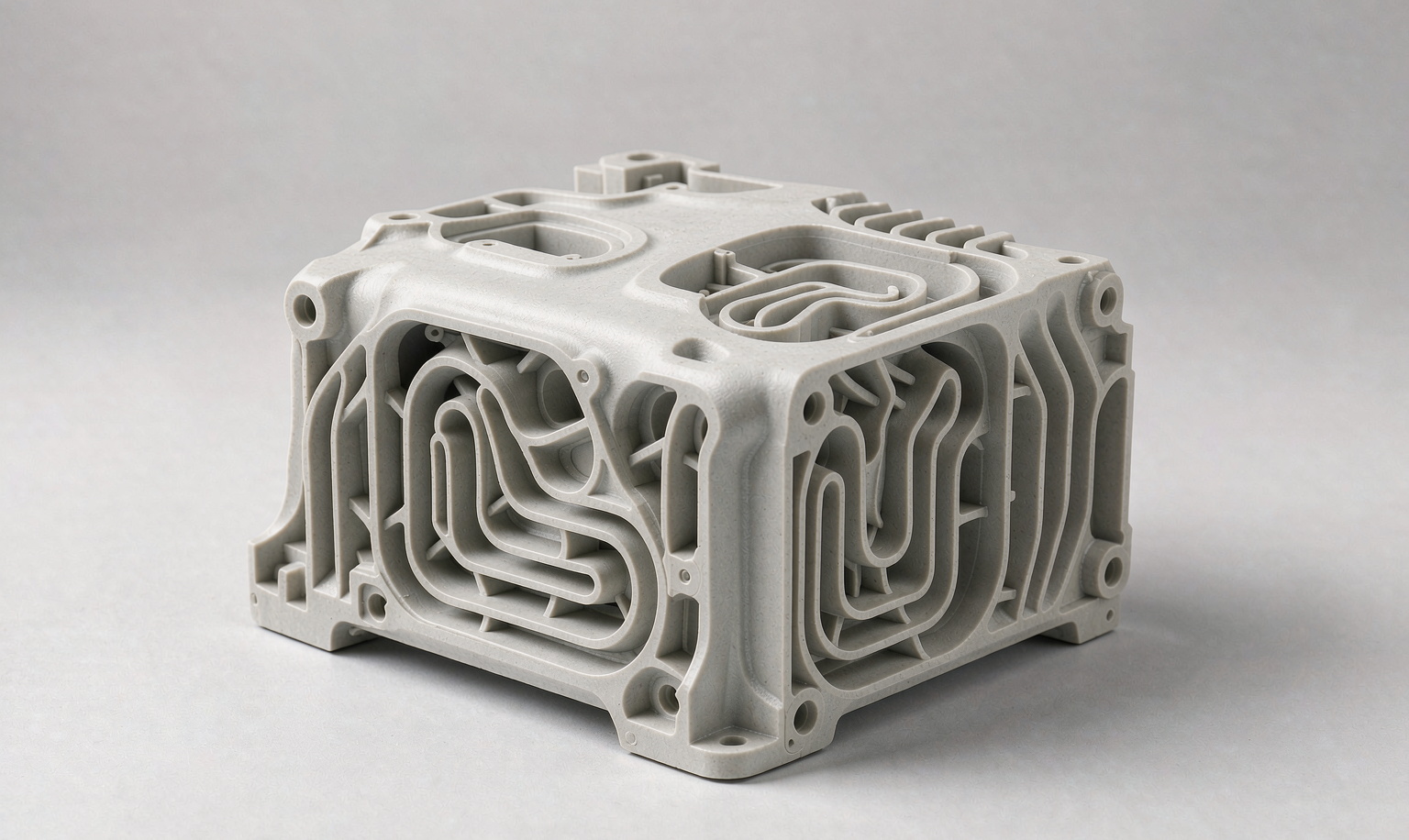
3D printing vs injection molding is a process-fit decision, not a cost race you settle once: each process wins on different ground — volume, geometry complexity, and supply-chain risk — and the right answer changes with every part you design. Get that fit wrong and the cheaper-looking process becomes the expensive one.
The Founder Who Molded a Part That Wanted to Be Printed
Marco ran a small connected-home brand and was six weeks from a crowdfunding deadline. His hero product was a desktop air-quality sensor wrapped in a passive-cooling shroud — a thin shell with internal air channels that routed airflow across the electronics. His SLS-printed prototype looked fantastic. He sent the CAD to three molders.
Two came back with quotes that required dissolvable cores or four side actions to form the channels, which pushed the per-unit cost to roughly 3× the simple-shape estimate. The third said "redesign it as two snap-together halves" — which killed the passive-cooling performance that was the entire pitch of the product. He was stuck: a part that was either unaffordable or didn't work, and a launch date that wasn't moving.
We ran the numbers a different way. At his launch volume — about 1,500 units in the first quarter, with demand still uncertain beyond that — an industrial polymer additive part (MJF or SLS nylon) formed the internal channels natively, for zero tooling, at a per-unit cost that beat the molded part once you added mold amortization and the tariff on the tool itself. He could also revise the channel geometry every week from thermal test data. He launched on printed production parts, and moved only the simple secondary housing to molding once volume crossed 8,000 units.
That story is the whole article in miniature. The "3D printing vs injection molding" question is not "which is cheaper." It is "which fits this part, right now."
What "3D Printing vs Injection Molding" Actually Means in 2026
In 2026 the question isn't "which technology is better." It's "which process fits this specific part, at this volume, under this supply-chain constraint" — because the answer flips across those variables. Treating it as a permanent cost contest is what gets founders like Marco stuck.
The 2026 manufacturing landscape has blurred the old lines in three documented ways:
- Zetwerk's 2026 framework positions additive manufacturing (AM) as almost always winning below ~50 units (zero tooling, 2–5 day lead versus 4–12 weeks for tooled alternatives); AM competes from 50–500 units when geometry justifies it; traditional manufacturing wins above ~500 units — unless part consolidation applies.
- Met3DP's 2026 data shows metal AM cut assembly steps by roughly 25% and weight by up to 30–40% versus machined alternatives, while ASTM International trials recorded defect rates falling to ~1% by 2025, making AM viable for end-use components.
- LKK's 2026 supply-chain note makes the resilience case: a qualified digital part file can be sent to a certified print center anywhere in the world, replacing physical stockpiles with just-in-time local production and eliminating long freight lead times.
- Deloitte's 2026 Manufacturing Outlook credits disciplined rapid-NPI — which AM heavily enables — with 73% faster time-to-market, 92% first-pass yield, and 60% fewer field failures.
The two processes are no longer opposing teams. They are tools on the same bench, and the skilled move is to pick per part.
The Three Axes That Actually Decide the Fit
Three variables decide 3D printing vs injection molding: volume, geometry complexity, and lead-time or supply-chain risk. Geometry is the one founders systematically ignore. The cost conversation is real, but it's only one of three legs. The cost conversation is real, but it is only one of three legs.
Axis 1 — Volume and the Tooling Amortization Wall
This is the axis everyone already knows, so we will keep it short. Injection molding spreads a fixed tool cost across a large run; below the break-even point, that amortization makes each part absurdly expensive. We broke the exact math in our piece on 3D printing vs injection molding cost, but the headline is simple: molding wins on unit economics only after volume clears the wall, and tariffs can push that wall higher (more on that below).
Axis 2 — Geometry: Why Complexity Is (Almost) Free in Additive
In injection molding, complexity is expensive. In additive, it's nearly free — and this is the axis that should break most ties. A molded undercut needs a slider. An internal channel needs a dissolvable core or a multi-part assembly. Variable wall thickness causes sink and warp. Every "clever" feature adds tooling cost and yield risk. Additive simply lays down what the file describes — conformal cooling, internal lattices, a 12-part assembly consolidated into one.
Met3DP recorded assembly-step reductions of ~25% when several machined parts collapsed into a single AM part. For Marco's cooling shroud, the "impossible" internal channel was the easiest thing the printer did, and the feature that made his product worth buying. That is the geometry axis doing the deciding.
Axis 3 — Lead Time and Supply-Chain Resilience
In 2026 the tariff stack turned geography into a process variable, and additive manufacturing sidesteps both the tool tariff and the long pole of overseas tooling lead time. Section 301 duties on Chinese-origin molds under HTS 8480 add 25%, and the $800 de minimis exemption is gone for all origins. A $12,000 mold can quietly gain $3,000 in duty before the first part is even cut. Vietnam and Mexico avoid that exposure, but they reintroduce their own lead-time poles.
Additive manufacturing carries no tool tariff and no 8–14 week tooling wait. For launch quantities and for on-demand spare parts, that resilience is often worth more than a few cents of per-unit cost. The deeper logic sits in the average timeline prototype to mass production — every week of tooling lead time is a week your competitor uses to establish themselves.
Our Hardest-Learned Lesson: Fit Beats Prestige
The most expensive manufacturing mistake we see is choosing the "advanced" process for its reputation instead of the one that fits the part. It's a lesson hammered into us across two decades of carrying consumer electronics from whiteboard to mass production. We have watched teams chase "cutting-edge" additive for a part that a $3,000 mold would have made flawlessly and cheaply at volume. We have also watched others force a mold where consolidation-by-printing was the only way to hit the performance spec.
This is not abstract for us. The cross-domain method behind our 29 granted patents keeps surfacing the same meta-lesson: a metal 3D printing technique we studied only made sense once it was mapped onto chip-processing constraints — the technology was not "advanced" in a vacuum, it was right for that problem. The old engineering saying from the Foxconn-Apple lab still holds: there is no advanced process and no backward process, only a process that fits, and one that doesn't.
How do you decide between 3D printing and injection molding for a real production run?
Build the decision on the three axes above, and let geometry — not habit — break the tie. Here is the tree we actually use with clients:
- If your volume is under ~500 units and the part has internal channels, undercuts, or consolidation potential → 3D printing for production (MJF/SLS nylon or DMLS metal). You get function now, with zero tooling.
- If your volume is above ~5,000 units and the geometry is moldable → injection molding. The per-unit economics are effectively unbeatable.
- If you are still iterating the design weekly before launch → AM as a bridge. Tooling locks your shape; printing keeps it fluid. This is the same staged logic behind how to reduce manufacturing cost before tooling.
- If supply-chain resilience, on-demand spare parts, or distributed regional production matter → AM with a digital inventory, independent of tooling geography and tariff exposure.
- If you need saleable pilot units in under 12 weeks → AM or bridge tooling, not steel. Speed is a feature, not a compromise.
What This Looks Like at SciPure
At SciPure Tech (溯朴科技) in Shenzhen, our founder came out of the Foxconn-Apple joint laboratory with roughly two decades of carrying consumer-electronics and home products from concept to mass production. We hold 29 granted patents, and our founder was named a Shenzhen science-and-technology leadership talent in 2020. We are a product engineering advisor for consumer-electronics and home brands, managing the full journey from concept design to mass production — DFM optimization, injection molding, electronics assembly, QC systems, and supply chain development. That work runs on our own 2,000 m² production facility in Shenzhen's Guangming District (海鑫光高科技工业园), ISO 9001 certified, with IQC/IPQC/FQC/OQC full-process inspection and an AQL 1.0 outgoing standard — tighter than the AQL 2.5 most importers default to. We have capacity; what we sell is engineering judgment. Clients can build on our lines or take the design package back to their own factory — the engagement holds either way. You can see the full program context at www.scipure.net.
FAQ
Is 3D printing cheaper than injection molding?
3D printing is cheaper than injection molding at low volume because it has no tooling cost — you pay only for material and machine time. Injection molding becomes cheaper per unit only after the mold is amortized across enough parts, typically thousands of units. The practical answer to "3D printing vs injection molding cost" depends on volume, geometry, and 2026 tariff exposure: below the break-even point, printing wins; above it, molding usually does, unless part consolidation changes the math.
When should I use 3D printing instead of injection molding for production?
Use 3D printing for production when your part has complex geometry — internal channels, undercuts, conformal features, or several components that can be consolidated into one — and your volume is below the molding break-even point, or when you need weekly design iterations before launch. Additive is also the right call for on-demand spare parts and distributed regional manufacturing, where a digital file replaces physical inventory and tooling tariffs.
Can 3D printed parts be used as final production parts?
Yes. In 2026, industrial polymer processes (MJF, SLS) and metal processes (DMLS, binder jetting) produce end-use parts for aerospace brackets, medical devices, jigs, fixtures, and low-volume consumer products. ASTM International trials recorded defect rates near 1% by 2025 for metal AM. The part must be evaluated for strength, heat, finish, and chemical exposure — but "prototype only" is an outdated assumption for most low-volume applications.
How does the 2026 tariff stack change the 3D printing vs injection molding decision?
The 2026 tariff stack adds a 25% Section 301 duty on Chinese-origin molds (HTS 8480) and has removed the $800 de minimis exemption for all origins. That raises the true cost of injection tooling and pulls the molding break-even point higher, making additive manufacturing and bridge tooling more attractive for launch quantities. Compute landed cost at the current stack before you lock geography — the duty can decide whether the program is margin-positive at all.
What is design for additive manufacturing (DFAM), and when does it matter?
Design for additive manufacturing (DFAM) is the discipline of designing parts so additive processes make them strongly — optimizing orientation, support structures, wall thickness, and consolidation opportunities. It matters the moment you choose AM for production rather than prototyping, because a part designed for molding (draft angles, uniform walls, no internal features) wastes most of additive's advantages. Good DFAM turns "complexity is free" from a slogan into a real cost and performance edge.
The Principle
There is no advanced process and no backward process — only a process that fits, and one that doesn't. Choose the second-best process that fits over the best process that doesn't.
The old line in the building was: anyone can name the newest machine; few can tell you which one the part already chose. In 2026, when accelerators, tariffs, and lead times all pressure the clock, the founders who ship are the ones who stopped asking "which is better" and started asking "which fits this part, today."
If you have a product concept and want to know if it's manufacturable, send a written brief at www.scipure.net/inquiry.html. We'll review your design and tell you exactly where the risks are.
Your light next step: reply with "PROCESS" and we'll send you our one-page Process-Fit Decision Sheet — the three-axis tree above as a printable checklist, plus the volume thresholds where molding actually wins. It's the same map we use on every program.
Related deep resources: