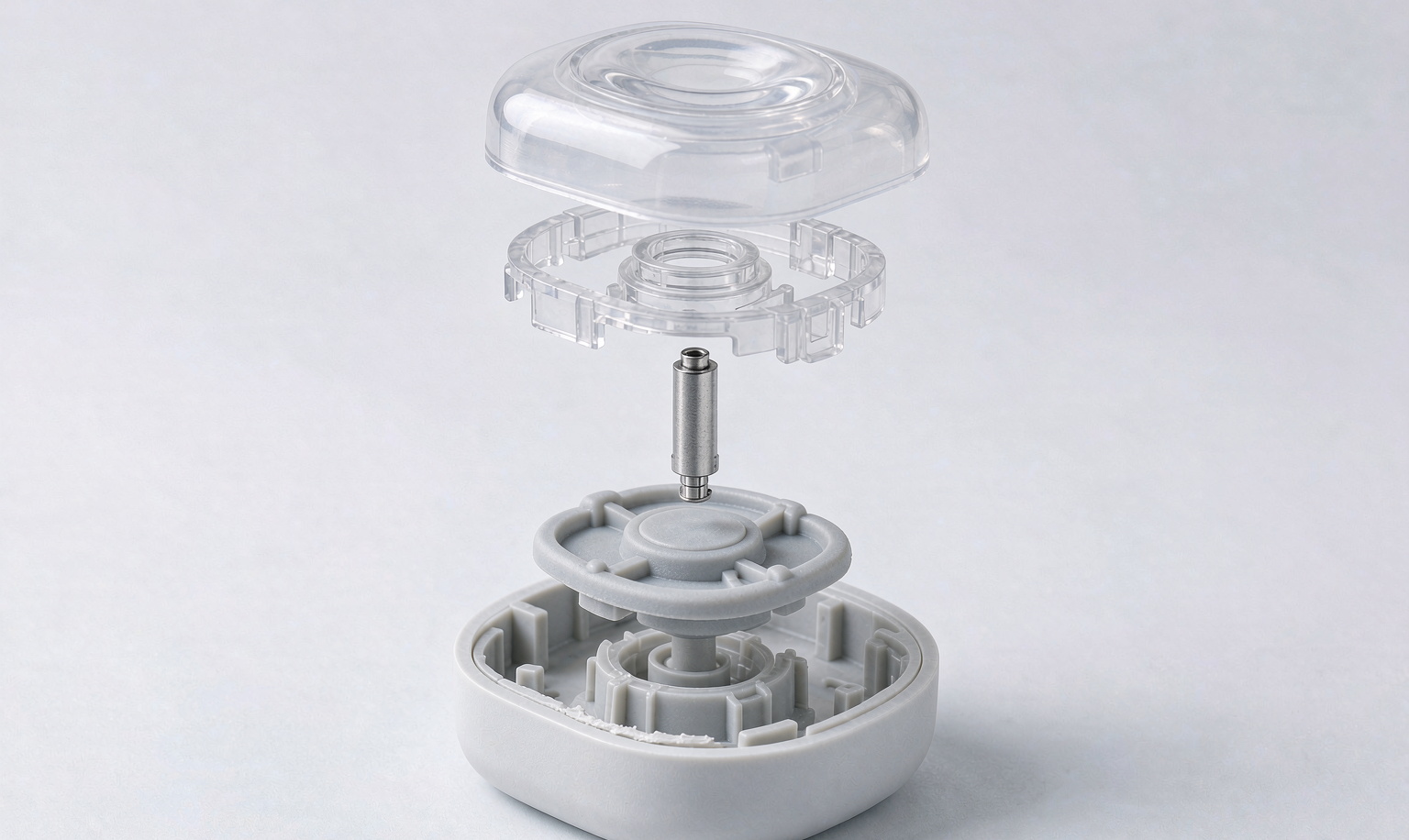
The prototype to mass production gap is the distance between a prototype that works because a person fixed it by hand and a product that has to work because the drawing says so. Most founders meet it the same way: the demo on the desk is flawless, the first mold quote is three times the number on the pitch deck, and somewhere in between a supplier says the quiet part out loud — "this can't actually be built the way you've drawn it."
The 2 a.m. Panic: A Prototype That Worked — Until It Didn't
I'll tell you about Dana. Not her real name. She'd spent eight months on a smart-home dial — a small rotary controller that felt, in her words, "like turning a safe." The prototype on her desk was beautiful. It clicked. It spun. It sat on a trade-show table for two days and impressed every buyer who touched it. Then she sent the CAD to three molders. Quote one came back at $14 a unit. Quote two, $11. Quote three — the one she liked — said they couldn't hold the tolerance on the detent without a multi-slide tool, and the sub-assembly "as drawn" would need hand-fitting. Hand-fitting, at 20,000 units a month, is not a process. It's a confession.
Here's what the quote didn't say, and what we found in an hour: Dana's "working" prototype had been modified by her own hands, and the file had never caught up. She'd sanded one edge so the cap seated cleanly. She'd tuned the press-fit by feel — a few thousandths tighter than the drawing called for, because the prototype material was slightly different from the production resin. And she'd bonded the internal bracket to the base with a dab of adhesive the CAD didn't mention at all. Every one of those fixes lived in Dana's memory and her fingertips. None of them lived in the file. So the factory would build the file — a stripped-down, optimistic version of what she'd actually proven out — and that version would not work. She hadn't designed a product that couldn't be manufactured. She'd designed a product whose working version had never been written down.
That, in plain terms, is the prototype to mass production gap.
The Panic Is Real — but the Gap Was There Before the Quote
Dana's 2 a.m. panic is the symptom. The disease is older. A prototype is a one-off artifact built by the person who understands it best, under no time pressure, with the freedom to fix anything that goes wrong mid-build. Production is the opposite: it builds the file, at volume, with people who have never seen the working prototype, under schedule pressure, with no permission to improvise. The moment you hand a factory a CAD model instead of a working sample, you've asked it to reconstruct the knowledge that made the sample work — and you've given it the one document that's missing that knowledge.
The research backs the stakes. OPD Design's 2026 guide frames this as the "industrialization gap" and puts roughly 70% of manufacturing cost as locked in during the design phase, not at tooling or production. Their data: products designed without manufacturing in mind typically need 2–4 extra revision cycles, adding 3–6 months and often blowing the original budget by 50% or more. That's the gap, quantified — and it's almost always a knowledge gap, not a capability gap. The factory could build it. The file doesn't tell them how.
What the Prototype to Mass Production Gap Actually Means for Your Budget
Look, the reason this matters to a founder isn't philosophical — it's on the cap table. The gap shows up as three line items nobody budgeted:
- Re-tooling and engineering-change orders after the first article inspection reveals the file doesn't match reality.
- A pilot run that fails acceptance because the as-built prototype was better than the as-drawn product.
- A launch delayed 8–12 weeks while someone reverse-engineers the tacit fixes and writes them back into the CAD and the process docs.
This is the part a spreadsheet misses. A BOM built from an un-updated prototype understates cost and overstates readiness at the same time.
Here's the management translation, drawn from how this is handled at the scale we came from. At the Foxconn-Apple joint laboratory, the hand-built "golden sample" an engineer assembles to prove a concept is never the manufacturing method. It's a reference. The real work is translating what the sample taught — every deviation, every hand-tuned fit, every material swap — into controlled process documents: tolerances, fixtures, work instructions, inspection criteria. The sample proves the idea. The documents prove it can be built 20,000 times. Skip the translation and you've shipped a prototype, not a product.
A procurement lead at a home-appliance brand put it bluntly: "We cut about 60% of our late-stage engineering queries once we required the prototype's deviations to be documented before we'd quote tooling. The molders had been quoting a cleaner part than we'd actually built."
How Do You Close the Prototype to Mass Production Gap Without a $50K Lesson?
You close it by treating the prototype as a hypothesis that must be re-encoded, not a finished design. The fix is cheap if you do it before tooling and expensive after. Find the line that sounds like you:
- If your prototype was hand-modified and the CAD wasn't updated → stop. Reconcile the file to the working version first. Every deviation between what you built and what you drew is a future failure mode at volume.
- If you're still in CAD → run a design for manufacturing pass now, alongside the build, while fixing the model costs minutes. This is also where manufacturing feasibility is first truly tested — and it's the same discipline behind how to reduce manufacturing cost before tooling, because the earlier the review, the cheaper the change.
- If tooling is already quoted → demand a DFM report tied to that exact quote, and specifically ask it to flag where the prototype differs from the drawing. A generic DFM won't catch a tacit fix; a targeted one will.
- If you have a working prototype but no production process → build a pilot run of 50–200 units before committing to volume. IoT Journal's manufacturing guidance puts a sensible pilot at 50–200 units with a failure-rate target below 1% at end-of-line test — small enough to surface the gap, cheap enough to absorb.
The 2026 twist: AI-native DFM tools — CoLab, SimuTecra's analysis, and others — now flag draft angles, thin walls, and impossible tolerances the instant you model them, which is a genuine leap from the old "find it after release" world. But be clear-eyed about the limit. These tools read the file. The prototype to mass production gap is precisely the knowledge that isn't in the file. An AI will confidently clear a drawing that omits the hand-sanded edge, because the drawing is clean. The gap AI can't see is exactly the one that sinks you. Use the tool to catch the geometry; use a human who's stood next to the machine to catch the silence in the file. The cost curve that makes early capture worth 10× is the same one we lay out in the average timeline prototype to mass production.
What This Looks Like at SciPure
At SciPure Tech (溯朴科技) in Shenzhen, our founder came out of the Foxconn-Apple joint laboratory with roughly two decades of carrying consumer-electronics and home products from concept to mass production. We hold 29 granted patents, and our founder was named a Shenzhen science-and-technology leadership talent in 2020. We are a product engineering advisor helping consumer-electronics and home brands manage the full journey from concept design to mass production — DFM optimization, injection molding, electronics assembly, QC systems, and supply chain development. That work runs on our own 2,000 m² production facility in Shenzhen's Guangming District (海鑫光高科技工业园), ISO 9001 certified, with IQC/IPQC/FQC/OQC full-process inspection and an AQL 1.0 outgoing standard — tighter than the AQL 2.5 most importers default to. We have capacity; what we sell is engineering judgment. Clients can build on our lines or take the design package back to their own factory — the engagement holds either way. More on the program at www.scipure.net.
FAQ
Why does the prototype to mass production gap appear even when my prototype works perfectly?
Because a prototype usually works thanks to hands-on fixes — sanding an edge, tuning a fit by feel, bonding a part the drawing omits — that never get written back into the CAD. The factory builds the file, not the working prototype, so the version it produces is a stripped-down, optimistic version that may not function. The product isn't unmanufacturable; its working version was simply never encoded. Document every deviation between what you built and what you drew before you quote tooling.
What is the prototype to mass production gap, in plain terms?
It's the distance between a prototype that works because a person fixed it and a product that must work because the drawing says so. The prototype is a one-off built by its expert under no pressure; production builds the file at volume with people who've never seen the sample. If the knowledge that made the prototype work lives only in a person's hands, the factory can't reproduce it. Bridging it means re-encoding that tacit knowledge into the CAD, process docs, and inspection criteria.
When should I bring a manufacturing partner into the prototype stage?
Earlier than feels natural — ideally while the CAD is still being built, not after the prototype is "done." A manufacturing partner caught early can flag where the prototype differs from the drawing and where the chosen process will fight the design, when a fix costs minutes rather than a mold revision. At minimum, bring them in before any tooling is quoted. The cost-of-change curve is exponential; the same issue is an email in CAD and a five-figure emergency after tooling.
What does a DFM report actually capture before tooling?
A good pre-tooling DFM report captures the features that drive process cost and yield: tolerance strategy, draft and wall thickness for molding, undercuts and side actions, material grade versus function, part count and assembly steps, and any feature forcing special tooling. For closing the prototype gap specifically, it should also flag where the prototype deviates from the drawing — the hand-applied fixes the file is missing. The output should be a short list of changes that lower cost or risk, not a generic compliance note. See design for manufacturing reduce manufacturing costs for the cost levers a DFM review protects.
How big a pilot run do I need before mass production?
Typically 50–200 units, scaled to product complexity, is enough to surface the gap before you commit to volume. The goal is to find the failure modes that only appear when real process variation replaces hand assembly — and to confirm the as-drawn product actually performs, not just the as-built prototype. Treat a pilot failure rate above about 1% at end-of-line test as a stop sign, not a surprise, and resolve it before full production.
The Principle
The anti-intuitive truth: a prototype proves the idea works. It does not prove the file is buildable. The prototype to mass production gap is a knowledge-transfer problem wearing a manufacturing costume.
The engineering proverb we live by: the factory builds your file, not your prototype — so make sure the file contains the working version.
If you have a product concept and want to know if it's manufacturable, send a written brief at www.scipure.net/inquiry.html. We'll review your design and tell you exactly where the risks are.
Your light next step: reply with "PROTOTYPE" and we'll send you our one-page Prototype-to-Production Readiness Checklist — the deviation-capture steps above as a printable list, plus the exact questions to ask a molder before they quote. It's the same map we use on every program.
Related deep resources: