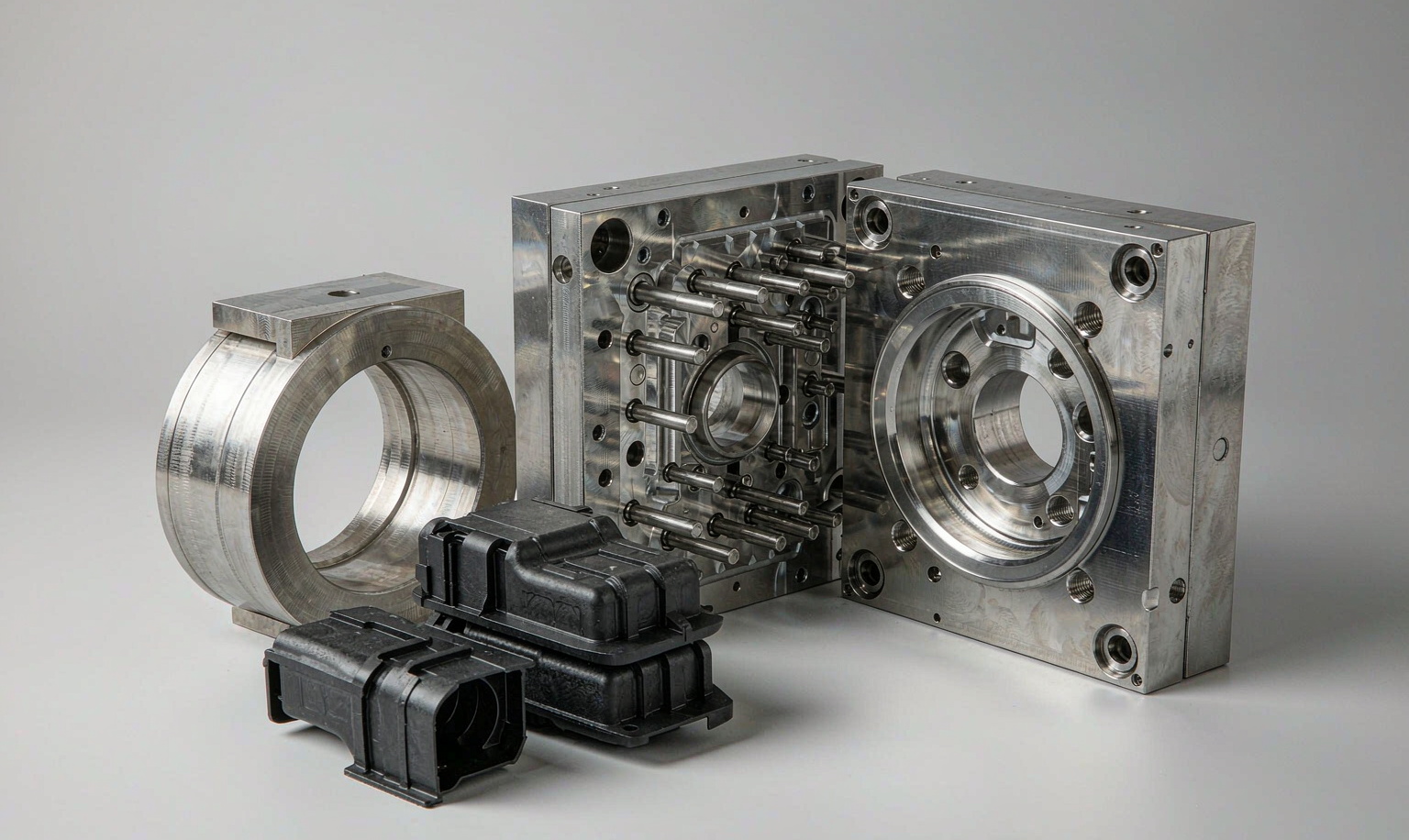
Low volume manufacturing is the production band where you have enough demand to need real tooling and not enough volume to earn that tooling back — a few hundred units, a few thousand, occasionally 10,000, almost never 50,000. It is not mass production with smaller numbers. It is a different buying decision wearing the same clothes, and the tell is that every quote you receive will be built on a volume assumption you have not earned yet.
We sit in these reviews constantly, and the same scene plays out: a founder compares two unit prices, picks the lower one, and finances a bet on a future that hasn't happened.
The Tuesday a $34,000 Mold Turned a $3.10 Part Into a $34 Part
Marcus builds a wall-mounted air quality monitor out of Denver. Nice product, real demand, first production run of 3,000 units for a spring launch into specialty retail. He sent the same CAD package to three shops and got two clean quotes back.
- Shop A: four-cavity hardened steel tool, $34,000, unit price $3.10 — quoted against an assumed 50,000 units a year.
- Shop B: single-cavity aluminum bridge tool, $6,500, unit price $6.80 at his actual 3,000 pieces.
He did what any rational operator does. He compared unit prices, picked A, and told his investors he had negotiated the part down 54%. On paper it was the obvious call. In reality he had just bought four cavities of capacity to serve a launch that only needed one, and he had bought it before the product had spent a single week in a customer's hands.
The season went fine until it didn't. He sold 1,900 units. Then his retail partner asked for a two-magnet mount instead of four — a small, sensible change that moved the boss geometry on the rear housing. On a four-cavity tool, that meant reworking four cavities and rebuilding a slide: $11,200 and five weeks. On the aluminum tool it would have been a re-machined insert and a long weekend.
That was the moment it landed. The part he had "negotiated down" was never $3.10. Add it all up, including duties paid on the mold itself at import:
- Steel four-cavity route: $34,000 tool + $13,906 duty + $11,200 modification + $5,890 parts (1,900 × $3.10) = $65,006 → $34.21 per unit actually made.
- Aluminum bridge route at the same 1,900 units: $6,500 tool + $2,659 duty + $1,200 modification + $12,920 parts = $23,279 → $12.25 per unit.
The "cheaper" mold cost 2.8× more per part. Nobody lied to him. Every number in both quotes was true. The mistake was upstream of the numbers: he compared prices at two different volumes and treated a capacity purchase as if it were a material purchase.
What Low Volume Manufacturing Actually Is — Three Routes, Not Two
Most buyers are shown two doors: 3D print it, or cut a production mold. The step in between is where most consumer hardware actually belongs, and it is under-quoted because it is less profitable to sell and harder to explain. Here is the honest band structure for injection tooling in 2026:
- Rapid / prototype tooling (aluminum 6061 or 7075): $1,500–$8,000 for a single cavity, typically 1,000–5,000 usable shots, mold in hand in 7–15 days. Re-machines fast, which is the whole point.
- Soft-steel bridge tooling (P20, pre-hardened): $5,000–$15,000, 10,000–100,000 shots, 3–5 weeks. Handles slides and lifters that aluminum can't hold, and transfers texture far better.
- Hardened production tooling (H13 or S136): $10,000–$100,000+, 300,000–1,000,000+ shots, 6–16 weeks. Multi-cavity, optimized cooling, hot runner if the resin is expensive.
The reason this matters more than any unit price is how violently tooling amortization behaves at the bottom of the curve. Take a mid-size ABS part on an $8,000 bridge tool:
- 100 parts → $82.05 per part
- 1,000 parts → $10.05
- 5,000 parts → $3.65
- 20,000 parts → $2.45
- 100,000 parts → $2.13
At 100 units, tooling is roughly 97% of your total cost. At 100,000 it is about 4%. Which means: at low volume, the unit price is almost entirely a measurement of your tooling decision, not of the part. You are not buying plastic. You are buying the tool that makes the plastic, and paying for it in one lump.
Why Unit Price Comparison Breaks Below 5,000 Units
Two things quietly invalidate a per-part comparison in the low volume band.
The first is that a quoted unit price is a volume artifact. When Shop A says $3.10, it means $3.10 if you take 50,000 a year, because that price assumes the tool is amortized across that volume and the line runs long enough to hit its cycle-time target. Comparing $3.10 at 50,000 against $6.80 at 3,000 is not comparing two suppliers. It is comparing two different products — one of which includes capacity you have to pay for whether you use it or not.
The second is the duty layer, and it is the part almost nobody puts in the spreadsheet. A mold is a dutiable good in its own right when it crosses the border, separate from the parts it produces (CBP classified plastic injection molds under HTSUS 8480.71.8045 back in ruling NY N304145, and the classification still holds). In 2026 that means:
- Section 301 on tooling: 3.1% base duty + 25% Section 301 (Chapter 99 subheading 9903.88.01) ≈ 28.1% on an injection mold — and since July 24, 2026 a further 12.5% forced-labor duty (9903.05.31) stacks on top for Chinese-origin goods.
- Mold bases (HTS 8480.20.00.00): landed duty of about 40.9% as of November 2026 — 3.4% base + 25% Section 301 + 12.5% forced labor, before MPF/HMF fees.
- The rule that trips people up: the duty is charged on the tool, at import, once. It does not scale down if you never hit the volume.
Put plainly: over-buying tooling capacity is now about 40% more expensive than it was, and the penalty lands before your first shipment. A $34,000 mold you didn't need carries roughly $14,000 of duty with it. That is capital that never touches part quality, part cost, or your customer's experience. It just leaves.
At What Volume Does a Steel Mold Actually Pay for Itself?
Not at a fixed number, which is why the internet's favorite answer ("around 1,000 to 5,000 parts") keeps failing people. A crossover point is arithmetic, not folklore. It is:
Tooling cost ÷ (per-part savings) = break-even quantity.
Vacuum-cast urethane at about $45 a part versus an $8,000 aluminum tool at about $3 a part: $8,000 ÷ ($45 − $3) = 190 units. Past 190 pieces, the tool has paid for itself. That is the mechanical version of the answer.
Now add the three things the simple formula ignores, because this is where low volume programs actually bleed:
- Duty on the tool. Add ~28–41% to the tool cost before you start the division. The break-even moves up by roughly the same proportion.
- Probability of one design change. Assume a 30–50% chance of one meaningful revision before volume is proven, and price the revision at 15–40% of tool cost for steel (far less for aluminum, because you can re-machine it instead of rebuilding it).
- Inventory you pay for twice. A 3,000-unit first run on a product that sells 1,900 leaves 1,100 units of working capital sitting in a warehouse, plus storage. That is a cash-flow cost that never appears on a quote.
Run all three and the honest crossover for a steel production tool usually lands 30–60% higher than the folklore number. Which is to say: if you are planning 3,000 units, the steel tool is usually not a cost optimization. It is a bet.
What Low Volume Manufacturing Really Asks You to Buy
Reframe the purchase and everything gets clearer. At low volume you are not buying parts at the best price. You are buying decision rights — the ability to change your mind cheaply, at the exact moment the market starts telling you what's wrong.
That is what a soft tool actually is: an option premium. You pay $3,000–$8,000 for the right to be wrong once, in real production material, at real cycle conditions, with parts good enough to put in a customer's hands. If the design holds, you graduate to steel and amortize it over volume you now have evidence for. If it doesn't, you spent a rounding error instead of a season.
A product manager we work with put it better than any consultant could: "I stopped asking for the best unit price. Now I ask what it costs me to change my mind in March."
The trap is subtle, because buying tooling early feels like discipline. It looks like commitment, it looks like scale, and it makes the pitch deck look mature. But commitment is only a virtue when your information is good. At 3,000 units your information is not good yet. That is the entire definition of the band you are in.
A Decision Tree for Low Volume Programs
Use this to place your program before you approve any tooling spend:
- If you are under ~300 units and the design is still moving → no tool at all. Vacuum-cast urethane or CNC in the production resin. You will pay $20–$50 a part and zero tooling, and every change is free. Do not let anyone sell you a mold at this stage.
- If you are 300–5,000 units and expect at least one more design change → single-cavity aluminum bridge tool, $1,500–$8,000. Plan on 1,000–5,000 shots and build the tight features (snap fits, sealing faces, bearing bores) properly from day one — geometry that gets "simplified for the prototype" is how projects lose three weeks later.
- If you are 5,000–30,000 units with a nearly frozen design → P20 soft-steel bridge tool, $5,000–$15,000, 10,000–100,000 shots. Go two-cavity only if you genuinely need cycle-rate capacity, not because it makes the unit price look better on the quote sheet.
- If you are above 50,000 units and the design is frozen → hardened H13 or S136, multi-cavity, hot runner if the resin is expensive. This is the only band where cavity count reliably pays for itself, and where a 40% duty bill on a big tool is amortizable instead of painful.
- If you genuinely don't know your volume yet → buy the decision, not the capacity. That sentence has saved more programs than any spreadsheet we've built.
How We Read a Low Volume Quote
The discipline we apply comes from the Foxconn-Apple joint laboratory our founder spent two decades in, where a program never opened with a production tool. It opened with a golden sample, then soft tooling, then a design freeze review that had to survive cost, quality and compliance at the same table. The tooling ladder wasn't a budget trick — it was how the organization bought the right to be uncertain in an orderly way.
SciPure Tech (溯朴科技) in Shenzhen is a product engineering advisor taking products from concept to mass production. Our founder came out of that joint laboratory with roughly two decades of carrying consumer electronics and home products from concept through mass production. We hold 29 granted patents, and our founder was named a Shenzhen science-and-technology leadership talent in 2020. We run our own 2,000+ m² ISO 9001 facility in Shenzhen's Guangming District with AQL 1.0 outgoing inspection — but what we sell is the engineering judgment that decides which mold you should cut and when. Clients use our lines, or take the design package back to their own factory; the engagement doesn't hinge on that choice.
If you want the surrounding engineering, the how to reduce manufacturing cost before tooling piece walks through the pre-tooling financial review, the design for manufacturing reduce manufacturing costs piece covers where cost actually gets locked, and the 3D printing vs injection molding cost piece handles the sub-1,000-unit end of the same curve. For scheduling, the average timeline prototype to mass production breakdown shows what each tooling stage does to your calendar. More on the practice at www.scipure.net.
The Principle
At low volume you are not buying parts. You are buying the right to change your mind — and the only mold that is genuinely expensive is the one you cut before you knew.
The shop-floor version of that rule has been around longer than any of us: mold soft, learn cheap, cut steel last.
FAQ
What counts as low volume manufacturing?
In injection molding, low volume usually means roughly 100 to 10,000 parts per run — the band where tooling cost is still a large share of total cost and the design may still change. Below about 300 units, tooling rarely pays and casting or CNC is cheaper. Above roughly 50,000 units per year, hardened multi-cavity steel tooling amortizes properly and per-part cost dominates the decision instead of tooling.
Is injection molding worth it for small batch production?
Often yes, but not with a production mold. A single-cavity aluminum bridge tool ($1,500–$8,000, 1,000–5,000 shots) gives you molded parts in the real production resin, with real shrinkage and real surface finish, at a fraction of steel cost. It is worth it whenever material fidelity or regulatory samples matter, and not worth it if the design will change more than twice.
At what volume does a steel mold pay for itself?
Divide tooling cost by the per-part savings: an $8,000 tool saving $42 a part breaks even at about 190 units. In practice, add duty on the tool (about 28–41% for Chinese-origin molds in 2026), the expected cost of one design revision, and the working capital of unsold inventory. Those three usually push the real break-even 30–60% higher, which is why "around 5,000 parts" is a starting point, not an answer.
How long does an aluminum prototype tool last?
Typically 1,000–5,000 shots, with simple geometry and benign resins sometimes reaching 10,000. Abrasive or glass-filled resins cut that down sharply. The practical constraint is usually not sudden failure but dimensional drift — after a few thousand cycles, cavity wear starts moving critical dimensions past tolerance, so plan your bridge run inside the tool's life rather than discovering the limit on your last 800 parts.
Can I run low volume now and scale to steel later without redesigning?
Yes, if you plan for it. Keep the part geometry and the critical features identical between the bridge tool and the production tool, and accept that cycle time and cooling layout will change. The risky shortcut is simplifying geometry for the prototype tool — thin walls, missing draft, or a reworked snap fit — because then your validations don't transfer and you pay for the same learning twice.
If you have a product concept and want to know if it's manufacturable, send a written brief at www.scipure.net/inquiry.html. We'll review your design and tell you exactly where the risks are.
Your light next step: reply with "LOWVOL" and we'll send you our one-page Low-Volume Tooling Decision Sheet — the three tooling routes with 2026 cost bands and shot lives, the break-even worksheet that includes duty and one expected revision, and the five questions to ask before you approve any mold. It's the same sheet we fill in before a tooling PO goes out.
Related deep resources: