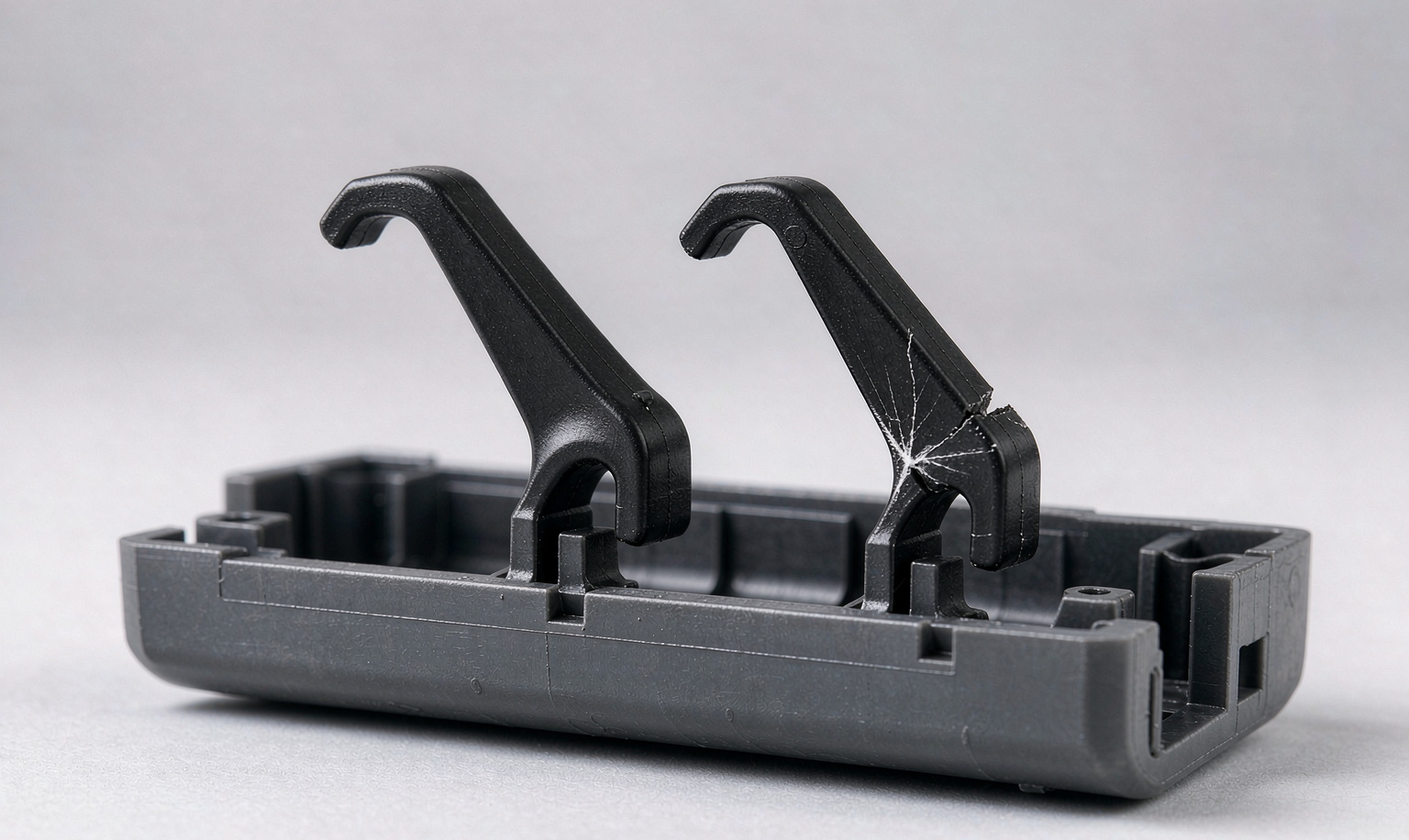
Snap fit design is the engineering of a plastic catch that joins two parts by bending elastically and springing back — no screws, no glue, no tools — and it is governed by a strain budget measured in fractions of a percent, not by whether the clip looks right in CAD. Get that budget wrong by a point or two and a feature that costs nothing per part becomes the most expensive line on your recall notice.
We review these constantly, and the same scene keeps repeating. A clip works beautifully in the prototype. Then it fails in production, and everybody is surprised — because nobody ever treated a two-millimeter hook as a loaded spring.
The Clip That Survived a Hundred Bench Cycles Snapped on Unit Seven
Elena had a compact countertop device headed into its first production run of 5,000 units. The two housing halves came together with six little injection molded snap fits — no screw bosses, no inserts, no assembly tooling. On the bench it felt perfect. She and her engineer opened and closed that housing maybe a hundred times over three weeks. Nothing moved, nothing whitened, nothing cracked.
Then the T0 samples arrived from the production tool. Same CAD, same nominal dimensions. On the seventh unit, one clip left a white stress line at its root. On unit twenty-three, a hook sheared off clean. Assembly stopped. She had a launch date, a deposit on the tool, and a housing that could no longer be closed twice.
The frustrating part was that nobody had done anything wrong in the obvious way. The toolmaker hit the dimensions. The CAD was clean. The prototype had passed every informal test they'd thrown at it. Elena's words to us were, "I genuinely don't know what changed between the samples I trusted and the parts I'm stuck with."
What changed was that she had been testing a print, not a production resin — and she had never once calculated the strain in that clip. This is the gap snap fit design exists to close, and it is almost entirely invisible until it is expensive.
Snap Fit Design Is a Strain Budget, Not a Feature You Draw
Here is the mental model that fixes most of these programs: a snap fit is not a catch. It is a leaf spring made of plastic, and like any spring it has a permissible deflection. During assembly the beam bends; the outer fibers stretch. If that stretch exceeds what the conditioned resin can take, you don't get a clip — you get a crack that starts at the root and finishes at the surface.
For a rectangular cantilever snap fit, the working estimate is:
ε ≈ 1.5 · t · δ / L² — where t is beam thickness, δ is the deflection needed to clear the undercut, and L is the free beam length.
Read that equation once and the whole design philosophy changes: long and thin beats short and thick, every time. Doubling length quarters the strain. Doubling thickness doubles it. Most failed clips are simply too short and too fat, because somebody drew a hook that looked sturdy.
The strain you are budgeting against depends on the resin, and the spread is brutal. Conservative allowable outer-fiber strain for a one-time assembly, drawn from supplier design manuals, runs roughly:
- PP, POM (acetal): 7–8% — the classic spring resins, forgiving and widely used for living hinges.
- PA6 / PA66, dry as molded: 6–7% — excellent, but strength drops when the part absorbs moisture, so design for the conditioned state.
- PC and PC/ABS: 3–5% — tough and great-looking, notch-sensitive, so the root geometry has to be generous.
- ABS: 2–4% — the workhorse of consumer housings, and right at the edge for many clip designs.
- Glass-filled grades (PA66-GF30, PBT-GF30): ~1–2% — fibers kill ductility. A clip sized for unfilled nylon will fracture immediately in the filled version.
That last line is the one that catches experienced teams. Someone swaps to a stiffer resin to fix a different problem and quietly removes two-thirds of the clip's strain allowance. Published comparisons put a design rule of thumb at keeping assembly strain near 70–90% of yield for one-time fits — less if the part will be opened repeatedly.
Why the Prototype Lied to You
Elena's hundred bench cycles were real. They just weren't testing the thing that shipped. A printed or machined prototype differs from an injection molded part in three ways that matter to a clip:
- Material. SLS nylon or a CNC machined sample is not the production ABS. Different elongation at break, different notch sensitivity, different response to a sharp internal corner. The print could bend further and recover; the molded resin cannot.
- Flow and orientation. In a molded clip, polymer chains and any glass fibers align with the melt flow. A load pulling across that direction meets weaker, faster-failing material. A print has no weld line. Your production part almost certainly does.
- Gate and weld line location. If the flow fronts meet at the root of the beam — the highest-stress point on the whole feature — you have put a structural weak seam exactly where the bending moment peaks. A weld line in a glass-filled resin can retain less than half the bulk strength.
None of this shows up in a visual inspection or a hand-bend test. Which is why the honest version of "it worked in the prototype" is "it worked in a different material made by a different process." That distinction is the whole ballgame, and it sits squarely inside design for assembly discipline rather than model-making.
The Four Places a Snap Fit Quietly Fails
Once you accept the strain budget, four details explain nearly every field failure we get called in to look at. Each one is small, each one is cheap to fix on paper, and each one is expensive after T0.
- The root radius. A sharp 90° corner at the beam root concentrates stress by roughly 3× nominal. A radius of at least 0.5× the wall thickness — many designers use 0.6t — lets the stress flow around the corner. This single dimension is the most common cause of cracks after repeated opens.
- Taper. A beam that is 30–50% thinner at the tip than at the root distributes bending strain along its length instead of hoarding it at the base. Published guidance puts the allowable-deflection gain from tapering around 40–60%. A uniform cross-section is almost never optimal.
- Undercut depth and angles. Retention undercut is usually 0.5–1.5 mm; deeper needs a longer beam or a mold slide. A 30–45° lead-in converts push force into beam deflection efficiently; a steeper retention face locks harder but makes service access brutal. Deeper undercuts also force side-actions — lifters or slides that add roughly $2,000–$5,000 each to the tool.
- Creep and stress relaxation. Plastics under sustained load keep moving. A clip that stays bent after assembly will lose retention force over months — faster in a hot car interior or near a motor. The fix is counterintuitive but simple: design the clip to spring back to a zero-stress state once the hook engages. If it must hold preload, size it for the relaxed force years later, not the fresh force on day one.
Notice that only one of those four is about the hook geometry everyone sketches. The other three are about material behavior, mold flow, and time — which is exactly why a visual CAD review misses them.
How Much Does a Snap Fit Save — and What Does a Failure Cost?
The reason teams reach for clips in the first place is legitimate. A well-designed snap fit adds essentially zero part cost and zero assembly labor. Industry estimates put a single joint at about $0.03–$0.08 in avoided screws, brass inserts, and assembly time. On a housing with six clips, that is roughly $0.30–$0.50 per unit — say $30,000–$50,000 a year at 100,000 units. Against that, the mold complexity for a few undercuts recovers within roughly 10,000–20,000 parts.
But the arithmetic flips hard when the clip fails. A housing that cannot close is a 100% functional scrap rate until the tool is fixed. A reworked cavity plus a slide can run $10,000+ and five weeks. And in 2026 the fix carries a new weight: a Chinese-origin steel modification tooling change is landed at roughly 28–41% in duties (base + Section 301 + the 12.5% forced-labor duty in force since July 24, 2026), charged on the tool at import whether the design was right or not. A "free" fastener that needs a re-cut is suddenly the least free line in the program.
This is the same logic we use in the design for manufacturing reduce manufacturing costs review: the money is decided long before the quote, in the geometry and the material call. It is also why the how to reduce manufacturing cost before tooling conversation always includes the clip detail — changing a hook after steel is cut is a different category of expense from changing it in CAD.
A Decision Tree Before You Cut Steel
Use this to place your own clip before you approve a tool:
- If the housing will be opened fewer than ~10 times in its life → design for one-time assembly, allow up to ~80% of the resin's yield strain, and use a releasable-but-firm retention face. Optimize for secure closure, not serviceability.
- If it is a serviceable cover opened by a customer → cap strain near 50% of yield for fatigue life, use a generous root radius and a moderate retention angle, and cut a real pry slot with a fulcrum. A cover labeled "serviceable" with no tool access is a cover that gets broken open.
- If the resin is glass-filled or brittle (PMMA, PPS, GF grades) → do not force a snap fit. Strain allowance is 1–2%. Use a screw, a metal insert, or an elastomer gasket with a separate retainer instead.
- If your only validation is a printed or machined sample → you have not validated the clip. Mold a single-cavity bridge tool in the production resin, or at minimum run flow analysis to locate the weld line before you commit to production steel. The 3D printing vs injection molding cost piece covers where that bridge step sits on the cost curve.
- If the clip must hold parts together under sustained preload or heat → redesign it to relax after engagement, or add a crush rib/foam preload and accept that the plastic clip is positioning, not clamping.
How We Review a Snap Fit Before Tooling
The discipline comes from the Foxconn-Apple joint laboratory where our founder spent two decades. There, a clip was never reviewed as a drafting detail. It was reviewed as a loaded interface that dragged four departments into the room at once: structure sized the beam, tooling placed the gate and the slide, materials signed off the conditioned strain limit, and quality defined how retention force would be measured on the line. One small hook, four owners — that cross-functional reflex is what most first-time hardware teams don't have, and it is why a clip that "looks fine" reaches T0 and fails there.
SciPure Tech (溯朴科技) in Shenzhen is a product engineering advisor taking products from concept to mass production. Our founder came out of that joint laboratory with roughly two decades of carrying consumer electronics and home products through development. We hold 29 granted patents, and our founder was named a Shenzhen science-and-technology leadership talent in 2020. We run our own 2,000+ m² ISO 9001 facility in Shenzhen's Guangming District with AQL 1.0 outgoing inspection — but what we sell is the engineering judgment that decides whether your clip survives assembly. Clients use our lines, or take the design package back to their own factory; the engagement doesn't hinge on that choice.
For the surrounding schedule, the average timeline prototype to mass production breakdown shows where a clip redesign lands if you find it at T0 instead of in CAD. More on the practice at www.scipure.net.
The Principle
A snap fit is not a feature you draw. It is a spring you specify — and springs do not care how sturdy they look.
The shop-floor version has been around longer than any of us: design the clip as a spring, or pay for it as a recall.
FAQ
What does a snap fit design review actually check before tooling?
A proper snap fit design review checks five things: the allowable strain of the conditioned production resin against ε ≈ 1.5tδ/L²; the root radius (at least 0.5× wall thickness); beam taper and length-to-thickness ratio (5:1 to 10:1); gate location and weld-line position relative to the beam root; and whether the clip relaxes to a zero-stress state after engagement or holds preload that will creep. Any review that only checks the hook angles has missed the four places clips actually fail.
Why do plastic snap fits break on the first assembly?
Usually because the beam strain exceeded the resin's permissible strain. Common causes: a beam that is too short or thick, a sharp root corner that concentrates stress ~3×, a weld line sitting at the root, or a glass-filled resin substituted for an unfilled one (which cuts allowable strain from ~6% to ~2%). A prototype that survives hand-bending does not prove the production molded part will — the material, flow orientation, and gate location all change.
Do snap fits loosen over time?
Yes, if they stay deflected. Plastics creep under sustained load, so a clip held bent loses retention force over weeks or months, faster at elevated temperature. The fix is to design the hook so the beam springs back toward its unloaded position after engagement. If the clip must hold constant preload, specify it using long-term creep-modulus data at the service temperature and test retention after heat aging — not with a fresh room-temperature pull test.
How much deflection is too much for a plastic snap fit?
Compare calculated strain against the resin supplier's allowable value. As a starting point for one-time assembly: PP and POM tolerate roughly 7–8%, nylon 6–7% dry, PC/ABS 3–5%, ABS 2–4%, and glass-filled grades only 1–2%. For a repeatedly opened cover, stay near half those figures. When in doubt, lengthen the beam rather than thinning it below strength — and validate with a molded sample, not a calculation alone.
Can I use the same snap fit design for 3D printing and injection molding?
No. Printed beams fail differently: FDM layer lines become crack planes if the hook is oriented poorly, while SLS nylon is far more ductile than production ABS. Sizes also drift with print orientation. Use printed clips to check assembly motion and ergonomics only. Validate strain, weld lines, and retention on injection molded samples in the actual production resin before you approve a production tool.
If you have a product concept and want to know if it's manufacturable, send a written brief at www.scipure.net/inquiry.html. We'll review your design and tell you exactly where the risks are.
Your light next step: reply with "SNAP" and we'll send you our one-page Snap-Fit Design Review Checklist — the strain quick-check equation with allowable strain by resin, the root-radius and taper rules, the gate/weld-line questions to ask your molder, and the five conditions that decide whether a clip is one-time or serviceable. It's the same sheet we fill in before a housing tool goes to steel.
Related deep resources: